Trump 2.0: Is China Filling the Void?
Despite the perception that China is actively exploiting the perceived missteps by the Trump administration and filling the void that Washington has left in the world, the actual picture is more complicated, and it defies a singular generalization. U.S. allies and partners might have more questions regarding the U.S. But such questions have not translated into a genuine swing toward China. In functional areas, China’s bilateral aid budget has seen only marginal growth and its actual multilateral aid declined in 2026, far from even making a dent in the gap the U.S. left in global aid space. With the U.S. withdrawal, Chinese willingness to pay the costs to accommodate the demands of U.S. allies has depreciated rather than appreciated. But more importantly, while China’s ambitions may be present, its willingness to take on more responsibilities and burdens in the world has not grown simply because the U.S. is no longer as committed as it once was.
In the era of great power competition, any misstep by either the United States or China in international affairs is easily placed under the microscope for scrutiny as to how it gives a strategic advantage to the other side. Despite the second Trump administration’s visible pivot away from the narrative of great power competition,[1] the U.S. strategic community[2] and the rest of the world[3] are fascinated by the question of how President Trump’s grand strategy, which is at a minimum controversial, may have been actively exploited by China. Such cases are particularly salient in the case of America’s relationships with its traditional allies and its retreat from the foreign aid arena—arguably the most significant victims of President Trump’s “America First” foreign strategy.[4]
The equally salient question, however, is whether China has been able to take advantage of these perceived policy blunders/retreats by Washington. Such capitalization would presumably translate into a significant improvement in China’s relations with these allies and partners of the United States. This would occur both by Beijing’s active policy pursuit to benefit from the deterioration in their relations with the United States, and by virtue of these partners’ deliberate distancing of themselves from the United States and their pursuit of closer relationships with China. By unpacking the dynamics of China’s relationships with three blocs of traditional U.S. allies and partners and by analyzing China’s foreign aid contribution since 2025, this article seeks to assess the strategic gains, if any, that China has been able to draw due to the policies of the second Trump administration.
Europe
The Chinese policy community has defined the second Trump administration as the “most disruptive adjustment period” for America’s trans-Atlantic relationships since the end of World War II.[5] Once a pillar of the liberal international order anchored in the deep systematic cooperation across the security, economic, and ideological domains, the trans-Atlantic alliance has fallen victim to the “America First” philosophy of the Trump administration. In China’s view, Europe has been forced to systematically adjust its ideological, security, and trade alignment with the United States as well as to re-strategize with respect to its choice between “strategic dependence” and “strategic autonomy.”
Europe’s anxiety over its relationship with the United States has been exacerbated in particular by President Trump’s policies on trade and Ukraine.[6] On the trade front, Europe experienced rounds of volatile tariff fluctuations and eventually settled for the 2025 “Turnberry” deal that established a 15 percent tariff in 2025,[7] which was later replaced by a 10 percent tariff after the U.S. Supreme Court ruled on the earlier measures in February 2026,[8] alongside Section 232 tariffs that now apply to the full customs value of aluminum, steel, and copper products.[9] On the security side, Europe has been subject to some of the most traumatizing criticisms from its American ally in decades, including U.S. Vice President Vance’s confrontational speech at the 2025 Munich Security Conference that termed Europe’s biggest threat as internal—naming migration in particular—rather than any external threats such as those from Russia.[10] Later in the year, President Trump also heavily criticized Europe, calling it “weak” and saying that the European nations were “decaying.”[11] On the Ukraine war, President Trump has been pushing Europe and Ukraine to negotiate and accept that Russia has the upper hand and that they should concede.[12]
Shocked by America’s sudden disregard for its alliance, Europe has seen an accelerated debate about European independence from U.S. influence.[13] European leaders have avoided a full rift in the transatlantic alliance, and they have tried to engage and negotiate with the Trump administration as much as they can.[14] However, the pursuit of “strategic autonomy” rapidly picked up speed, with collaborative, cross-border defense initiatives such as “Security Action for Europe” loans transpiring faster than ever.[15] A European future without American leadership has suddenly ceased to be a remote possibility.
China acted quickly to embrace the potential for European strategic autonomy that it had long desired.[16] On various occasions, Chinese top leader Xi Jinping openly and publicly expressed his support for European integration and the continent’s strategic autonomy.[17] From the Chinese perspective, China does not have a fundamental conflict with Europe. Unlike the United States, which is the status quo power engaged in a structural conflict with China as a revisionist power,[18] in the Chinese view Europe is not a partner in the great power competition for supremacy.[19] While Europe and China have different cultures, histories, and, most importantly, different political systems, Beijing certainly does not see democracy and human rights as fundamental obstacles to the development of China-Europe relations. In the past, China had been baffled by the European countries’ persistent push for democracy and human rights issues related to China, which it attributed to Europe’s bias and desire to align relations with the United States.[20] Now it is Washington that has pivoted away from its commitment to and pursuit of democratic values in foreign affairs, so the Chinese see no reason why Europe should or would continue to be bogged down by what the Chinese perceive as “obstacles to the development of bilateral relations.”[21]
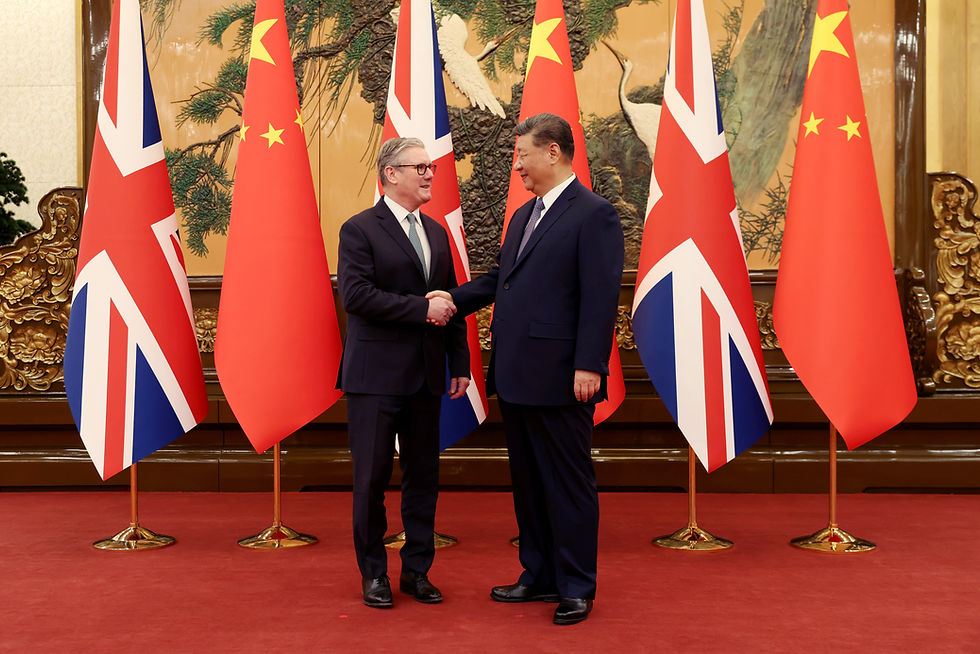
China’s interest in capitalizing on the transatlantic rift is obvious. In 2025 alone, Foreign Minister Wang Yi paid two visits to Europe, including EU headquarters, Germany, France, Austria, Slovenia, and Poland.[22] In 2026, he delivered a keynote speech at the Munich Security Conference and explicitly committed to support European security.[23] China’s efforts worked to entice senior European leaders—European Commission president Ursula von der Leyen and president of the European Council António Costa—to visit Beijing in July 2025 for the 25th EU-China Summit that marked the 50th anniversary of the establishment of diplomatic relations.[24] Between late 2025 and April 2026, the leaders of France, the UK, Germany, and Spain all visited Beijing,[25] marking a period of unusual enhanced senior-level diplomacy that saw the respecting leaders seeking dialogue, communications, and strengthened cooperation.
Despite the uptick in senior-level visits, which presents an image of growing symbolic diplomatic engagement, concrete deliverables that might signify strategic breakthroughs in China-EU relations remain scarce. The primary issue is that despite the rift between the United States and Europe, which arguably presents a great opportunity for China to enhance its relationship with Europe, China has not shown much leniency or benevolence toward Europe’s longstanding concerns. First, China has refused to cater to the European demand to press Russia to end the Ukraine war.[26] In fact, when such a request came up in a meeting with Kaja Kallas, vice president of the European Commission and high representative of the European Union for foreign affairs and security policy, Wang Yi openly told her that China will not accept that Russia lose its war with Ukraine.[27] Having spun the wheels for four years since the Russian invasion of Ukraine, Europe has consistently been frustrated by China’s “pro-Russia neutrality” in the war,[28] and Wang Yi’s comments were the latest nail in the coffin.
Second, Europe’s frustration with China’s trade policy has also not led to any meaningful change in Chinese behavior. In 2025, China’s trade surplus with the EU surpassed its surplus with the United States, reaching 392 billion USD.[29] Europe attributes this large trade imbalance to China’s state subsidies and to market access issues.[30] In addition, Europe is also concerned about China’s export controls on critical minerals that have been adeptly deployed in the escalation of its trade war with the United States but have also severely damaged European interests due to its high dependence on Chinese supplies.[31] While these issues were priorities during von der Leyen and Costa’s July 2025 visit to Beijing, most European trade grievances were left unaddressed.[32] China did offer modest cooperation on climate and rare earth exports to Europe, but its industrial policy essentially remained out of the conversation.
It is not that China does not want to exploit the opportunity created by the Trump administration to bring Europe closer into its orbit. The heart of the problem lies in the asymmetry between the respective demands on the two sides and their perceived negotiating positions. In the Chinese view, since Europe is falling out of favor in America and losing the support of its traditional security alliances with the United States, Europe’s negotiating position has deteriorated rather than improved.[33] As such, Beijing envisions a “more positive and pragmatic” approach by Europe toward China, including the removal or de-escalation of Europe’s traditional “biases” toward China on Taiwan, trade, and human rights.[34] While many have seen a great opportunity for China to expand its goodwill in Europe,[35] China has seen no need to bend over backwards to accommodate Europe.
Northeast Asia
The second Trump administration’s engagement in the West Pacific region is more complicated and thus more difficult to generalize. Overall, the United States has been working to adjust its security engagement and alliance strategy in the region, demanding more concessions from its allies on trade and a sharing of the costs of the alliances. However, in the Chinese view this U.S. strategy has resulted in a rather different outcome.
In the Chinese assessment, the second Trump administration might have demonstrated a retrenchment trend in its alliance relations to prioritize “America First,” but with respect to Japan, Washington has been advancing rather than diminishing the two countries’ security cooperation so as to “push Japan to the frontline of confronting China.”[36] The Trump administration has complained about Japan’s free-riding in the U.S.-Japan security alliance, and in July 2025 it forced Japan to accept a 15 percent reciprocal tariff agreement.[37] In the Chinese view, Japan has been required to elevate its defense spending to 3.5 percent of its GDP and has been pushed to embrace mini-lateral security cooperation within the QUAD and with the Philippines.[38]
Similarly, in South Korea the Trump administration has pushed for the modernization of the U.S.-ROK alliance, shifting from a peninsula-focused military pact to a comprehensive “strategic convergence,” integrating advanced technology, economic security, and regional security cooperation.[39] Key elements include the 2025–2026 initiatives for AI and quantum tech collaboration, 3.5 percent of GDP defense spending by Seoul, joint shipbuilding and defense industrial investment, and advances toward wartime operational control (OPCON) transfer. As demonstrated at the Busan Summit in October 2025, Seoul has managed the pressure from Washington relatively well.[40] However, challenges down the road remain.
By the summer of 2025 China is reported to have assessed that with the Trump administration’s retrenchment policy, there was a “strategic opportunity to improve relations with Japan and South Korea.”[41] The result was a plan to strengthen trade cooperation with Japan and South Korea in light of the U.S. trade war. In March 2025, after a five-year hiatus the trade ministers of the three countries—China, Japan, and South Korea—held their 13th ministerial meeting in Seoul.[42] They agreed to expedite trilateral FTA negotiations and strengthen supply chain cooperation and dialogues about export controls.[43] The broader backdrop to this meeting was the uncertainty generated by the U.S. tariff war, which, in the Chinese view, pushed the three countries toward regional trade negotiations.[44] This is in line with China’s outstanding aspiration to reshape the Northeast Asian security architecture around a China-led trilateral bloc comprised of China, Japan, and the ROK, with the United States playing a marginal role as a partner but not as a central pillar in an anti-China Northeast Asia security arrangement. There were also reports that China sought to use the issue of Korean peninsula denuclearization to reinvigorate trilateral security cooperation amid widespread speculation that the second Trump administration would pursue a rapprochement with North Korea, thereby helping to “undermine U.S. security alliances and its participation in regional security affairs.”
The desire to pull Japan and South Korea closer into the Chinese orbit certainly contributed to Xi Jinping’s decision to pay a state visit to South Korea in October 2025 and to meet with then-newly minted Japanese Prime Minister Sanae Takaichi on the sidelines of the APEC Summit.[45] Since the THAAD drama in 2016, when the United States deployed a THAAD system in South Korea to China’s ire,[46] Xi did not visit Seoul despite his visit to North Korea in 2019.[47] China was not pleased with President Moon Jae-in’s continued commitment to THAAD deployment in South Korea,[48] and it was antagonized by President Yoon Suk Yeol’s pro-U.S. stance.[49] When President Lee Jae Myung from South Korea’s progressive camp assumed office in June 2025, China finally saw an opportunity to improve relations with South Korea, hence Xi’s state visit alongside the APEC Summit.[50]
Japan is a more complicated story. Xi met with then-Japanese Prime Ministers Fumio Kishida and Shigeru Ishiba in 2022, 2023, and 2024.[51] But the decision to meet with Prime Minister Takaichi on October 31, 2025, within ten days of her election, was not without risks. Most notably, Takaichi has a reputation of being the “true heiress” of former Prime Minister Shinzo Abe, who was known for his hardline defense and foreign policies with respect to China and his friendly stance toward Taiwan.[52] When Prime Minister Takaichi made her controversial comments regarding a Taiwan contingency days after meeting President Xi in Seoul, the Chinese policy apparatus was criticized for failing to foresee the implications of her long-held views on Taiwan and for embarrassing the top leadership by not preventing Xi from meeting with her. This grievance has contributed to China’s harsh pushback against Japan since November of 2025.
In the context of relations between Japan and South Korea and the broader trilateral relationship, China tried to exploit the opportunity offered by the second Trump administration to sway the two countries’ alignment choices, strengthen bilateral and trilateral cooperation, and bring both countries closer into the Chinese orbit. The efficacy of China’s strategy varies significantly between that toward South Korea and that toward Japan. Seoul may have been more receptive to the Chinese strategy, with South Korean President Lee traveling to China on his first overseas visit of 2026.[53] But Japan has taken a much more hawkish direction independent of President Trump’s rapprochement with China. This may reflect the vastly different regional security outlooks of South Korea and Japan, as well as their differing receptiveness to a China-led regional security structure.
The counterargument in the case of South Korea would be that progressive presidents of South Korea have traditionally been more receptive to China’s role in the regional security architecture, and therefore the impact of the second Trump administration has not altered the course of what people would have expected from a progressive South Korean president. However, one can argue that, if anything, U.S. efforts to strengthen security ties with South Korea through examples, such as promised nuclear-powered submarines,[54] have only amplified South Korea’s desire to align with the United States.
Japan represents a case in which a U.S. ally remains firmly committed to countering China despite the retrenchment tendency of the Trump administration. Chinese attempts to reach out to Japan and shape its choices have effectively hit a wall, provoking only greater pushback.
The Middle East
The Middle East is another contentious region where the narrative of U.S.-China great power competition has been prevalent.[55] While the United States is widely accepted as the security provider in the Middle East, China’s economic engagement with the region has generated significant hope in the area that down the road China will become a more consequential great power in the Middle East . China’s balancing diplomacy between Iran and the Gulf states,[56] as well as its outreach to maintain strong ties with other regional powers, such as Turkey, Egypt,[57] and Israel,[58] have enabled China to keep a relatively detached position in the U.S. conflict over Iran.
That said, China has not refrained from using the U.S. conflict with Iran to paint a dire picture of the bankruptcy of the U.S. alliance system. Chinese official media have depicted the Iran conflict as having “loosened the U.S. alliance system and collapsed U.S. credibility as a hegemon.”[59] Most U.S. allies in Europe have refrained from directly participating in the military operations in Iran.[60] But the Chinese point to the “security dilemma faced by U.S. allies in the Gulf because they have to depend on the United States for security guarantees while being reluctant to be involved in the conflict.” China has also played up the reported U.S. relocation of missile defense systems and troops from the Asia Pacific to the Middle East, especially the complaints and grievances from allies such as South Korea.[61] The Chinese message is clear: U.S. hegemony is no longer either viable or credible.
In the Iran conflict, China has tried to frame and present itself as an alternative benevolent great power vis-à-vis the destructive force of the United States. Whereas the United States is the warmonger, China sees itself as the conflict mediator and peacemaker. Whereas the United States destroys, China shapes its own image as a creator and builder. According to Chen Wenxin from China Institutes of Contemporary International Relations (CICIR), China’s top international relations think-tank, “The United States as a great power is obsessed with seeking and maintaining its hegemony, focused on infiltration and revolution and frequently launching wars. The result is the chaos in the Middle East, backlash against itself, and harm to the international community.”[62] In comparison, China “has always opposed hegemonism and power politics in all forms” because “great powers should act like great powers, following the path of justice and righteousness to contribute more positive energy to the peace and development of the Middle East.”[63]
Recognizing the Arab countries’ strengthening of their security dependence on the United States in light of the Iranian attacks on their territory, China called for these traditional U.S. allies to reconsider their alignment choices because more military cooperation with the U.S. would “only deepen Arab countries’ involvement in the conflict and damage their national security.”[64] In the Chinese narrative, the Gulf countries became the target of Iranian attacks because they were allowing the United States to use military bases on their soil to launch attacks on Iran. Therefore, their security alliances with the United States have become the source of their insecurity, making them the targets of Iranian retaliation. The Chinese logic continues that the Gulf allies of the United States should therefore reframe their security alliances with the United States as a liability rather than as an asset, and consequently, in the future they should reduce their security involvement with the United States. Hopes of fostering a sense of strategic autonomy among the Middle Eastern countries are very similar to the Chinese push with respect to the European countries.
In China’s direct communications with the Gulf countries, Chinese leaders have refrained from referring to the United States with respect to the ongoing conflicts and tensions in the region or from criticizing the United States for causing regional instability. In his phone call with the crown prince of Saudi Arabia and his meeting with the UAE crown prince, for example, President Xi Jinping presented China only as a supporter of peace and a builder of regional stability.[65]
Given China’s close relationship with Iran and its continued political and military assistance to the country,[66] Beijing’s efforts to gain favor from the Gulf countries have not been as effective as some might have predicted. Traditional U.S. allies, such as Saudi Arabia and the UAE, have called for China to use its influence to moderate Iranian behavior, but there is no clear evidence that they are reducing their security cooperation with the United States or seeking closer alignment with China to improve their security.
A Foreign Aid Void
Other than specific regions, functional domains, such as international organizations, governance, and foreign aid, are also key areas in which China has been actively competing with the United States for broader influence. Weeks after its inauguration, the second Trump administration shut down the U.S. Agency for International Development (USAID) and canceled vast numbers of U.S. foreign aid projects. A key question that has since emerged is whether China will exploit the opportunity and fill this void. Presumably, if China is keen on capitalizing on the retreat of the United States from the international stage, foreign aid would be a great area in which to supplant and replace U.S. influence as well as U.S. soft power in the Global South and in the traditional donor community. Given that China’s 2025 foreign aid budget was made before the second Trump administration entered office, 2026 is the first year for China to put forward its own plan to fill the void.
However, China’s foreign aid budget demonstrates very little ambition, and there are no plans to fill the vast space vacated by the United States. According to official Chinese government data, the portion of the 2026 budget of the China International Development Cooperation Agency (CIDCA) that is dedicated to foreign assistance amounts to 68 million RMB (around 10 million USD), representing an underwhelming 3 percent increase from 2025. The CIDCA budget for international development cooperation is slightly higher, at 76 million RMB (around 11 million USD), but it actually represents a 1.37 percent decrease from the previous year.[67] The budget for foreign aid of the Ministry of Commerce, which manages the bulk of China’s bilateral foreign aid, increased from 22.4 billion RMB (around 3.27 billion USD) in 2025 to 23.4 billion RMB (around 3.4 billion USD) in 2026, representing a 4.41 percent increase.[68] This amount is consistent with the overall average of China’s aid in previous years. China has not published its complete aid data since 2018. But a 2024 Ministry of Commerce (MOFCOM) report puts the average annual amount of Chinese aid at 20.5 billion RMB from 2013 to 2022 (approximately 3.13 billion USD at the average exchange rate during this period).[69]
The amount China is spending on foreign aid is significantly lower than what the United States formerly spent through USAID. According to U.S. government data, in the 2023 fiscal year, the USAIDs budget was about 42 billion USD, including 17 billion USD for governance, 9.4 billion USD for humanitarian assistance, 6.9 billion USD for health and population, 3.6 billion USD for administrative costs, 1.3 billion USD for agriculture, 1.1 billion USD for education, 740 million USD for infrastructure, and 700 million USD for economic growth efforts.[70] Furthermore USAID was not the only U.S. government agency providing foreign assistance. The State Department had a budget of nearly 19 billion USD for foreign assistance, and departments like the Department of the Treasury (at about 2 billion USD), the Department of Agriculture, and others also provided assistance.
A similar trend also exists in China’s contributions of multilateral aid through international organizations. According to the official budget of the Chinese Ministry of Finance, China’s donations to international organizations decreased from 4.46 billion RMB in 2025 to 4.44 billion RMB in 2026, roughly a 0.5 percent reduction. The Ministry of Finance’s budget for international cooperation decreased further by about 17 percent, from 45 million RMB to 37.5 million RMB.[71] Despite widespread observations that China is increasing its financial contributions to international organizations to capitalize on the U.S. retreat, the Chinese government budget data simply do not support this argument. As such, the empirical data suggest that China has not taken the opportunity of the U.S. withdrawal from the international aid field to significantly increase its own spending on foreign aid. This does not mean China has refrained from finger-pointing at the United States for being hypocritical and irresponsible, but it remains to be substantiated that China is using the opportunity to exploit the vacuum left by the U.S. withdrawal.
Conclusion
Despite the conventional perception that China is actively exploiting the perceived missteps by the Trump administration and filling the void that Washington has left in the world, the actual picture is more complicated and defies this singular generalization. China clearly intends to undermine the U.S.-led world order, and it has taken the opportunity to criticize U.S. irresponsibility and lack of credibility and leadership. Wherever it can, China has actively promoted its alternative vision for global security, development, and governance as an implicit challenge to the U.S.-led international order. Chinese intentions and rhetoric are both clearly pointing in this direction.
However, when it comes to China’s relationships with specific U.S. allies and partners, as well as China’s actions in specific areas like international aid, the conventional wisdom that the world is shifting toward China and thereby creating a strategic environment in favor of China vis-à-vis the United States is not empirically accurate. U.S. allies and partners may have more questions regarding U.S. credibility, commitment, and leadership. Some of them, including its European allies, are looking to alternatives for their future security. Others, such as Japan, South Korea, and the Gulf countries, still closely identify with the United States as their security ally, and they choose to strengthen rather than weaken their ties with the U.S. Although some Gulf countries and others, such as South Korea, may be pursuing a closer concurrent relationship with China, this by no means suggests that their ties with China have come at the expense of the U.S.. In functional areas of international engagement, China’s performance in foreign aid space is even less impressive. Bilateral and multilateral aid budgets have seen only marginal growth or an actual decline, far from making any dent in the much-scrutinized gap left by the shutdown of USAID.
The reason for China’s inability to sway the world in its favor at a time of perceived absence of U.S. leadership is multifaceted. With the U.S. withdrawal, Chinese willingness to pay the costs to accommodate the demands of U.S. allies and partners has declined. Simply put, Beijing no longer sees these countries as occupying the same negotiating position now that the United States is less firmly supportive of them. More importantly, while China’s ambitions may be present, its willingness to take on more responsibilities has not grown because the United States is no longer as committed as it once was. China will not automatically assume the former U.S. role in the world simply because the United States is, for the moment, less present.
About the Contributor
Dr. Yun Sun is a Senior Fellow and Director of the China Program at the Stimson Center.
Notes
[1] See Scott R. Anderson, “Breaking Down Trump’s 2025 National Security Strategy: The Disappearance of Major Power Competition as a US Foreign Policy Priority,” Brookings, December 8, 2025, https://www.brookings.edu/articles/breaking-down-trumps-2025-national-security-strategy/.
[2] Among others, see Jeffrey Prescott and Julian Gewirtz, “China Goes on Offense: Beijing’s Plans to Exploit American Retreat,” Foreign Affairs, September 29, 2025, https://www.foreignaffairs.com/united-states/china-goes-offense.
[3] For example, see “China, Qatar...Rwanda: Who's Offering to Fill Void US is Creating with UN Retreat,” Firstpost, September 23, 2025, https://www.firstpost.com/world/china-qatar-rwanda-whos-offering-to-fill-void-us-is-creating-with-un-retreat-13936056.html.
[4] See Damien Cave, “How Trump Supercharged Distrust, Driving U.S. Allies Away,” New York Times, March 31, 2025, https://www.nytimes.com/2025/03/31/world/trump-foreign-policy-trust.html.
[5] Ding Chun and Luo Tianyu, “特朗普政府第二任期下欧美关系的深度重构与战略张力,” Foreign Affairs Journal, Spring 2025, https://www.cpifa.org/Site/There/Uploads/kindeditor/file/20250804/%e4%b8%81%e7%ba%af-CN.pdf.
[6] For an example of such anxiety over President Trump’s policies, see “European Leaders Warn of 'Downward Spiral' as Trump Threatens Tariffs over Greenland,” AP via PBS, January 19, 2026, https://www.pbs.org/newshour/nation/european-leaders-warn-of-downward-spiral-as-trump-threatens-tariffs-over-greenland.
[7] Federica Di Sario, “Europe’s ‘Good As It Gets’ Trade Deal Redefines Ties with Washington,” July 28, 2025, https://www.theparliamentmagazine.eu/news/article/europes-good-as-it-gets-trade-deal-redefines-ties-with-washington and Federica Di Sario, “The European Parliament Backs Unpopular U.S. Trade Deal—on its Own Terms,” The Parliament, March 27, 2026, https://www.theparliamentmagazine.eu/news/article/the-european-parliament-backs-unpopular-us-trade-deal-on-its-own-terms.
[8] Natalie Sherman, “Trump Brings in New 10% Tariff as Supreme Court Rejects his Global Import Taxes,” BBC, February 21, 2026, https://www.bbc.com/news/articles/cn8146l0n55o.
[9] Ryan Last and Daniel N. Anziska, “Metals Market Shake-Up: Higher Section 232 Tariffs, Broader Coverage, Narrower Relief,” Troutman Pepper Locke, April 6, 2026, https://www.troutman.com/insights/metals-market-shake-up-higher-section-232-tariffs-broader-coverage-narrower-relief/.
[10] American Presidency Project, “Remarks by the Vice President at the Munich Security Conference,” University of California Santa Barbara, February 14, 2025, https://www.presidency.ucsb.edu/documents/remarks-the-vice-president-the-munich-security-conference-0 and “A Week that Felt Like a Decade: Europe Reels from J.D. Vance’s Speech in Munich,” European University Institute, February 27, 2025, https://www.eui.eu/news-hub?id=a-week-that-felt-like-a-decade-europe-reels-from-j.d.-vances-speech-in-munich.
[11] Amelia Nierenberg, “Trump Calls Europe ‘Decaying’ and Suggests ‘Size Will Win’ in Ukraine War,” New York Times, December 9, 2025, https://www.nytimes.com/2025/12/09/us/politics/trump-europe-decaying-weak-ukraine.html.
[12] Ibid.
[13] Inti Landauro and Lili Bayer, “EU is at a Crossroads Towards More Independence, von der Leyen Says,” Reuters, January 21, 2026, https://www.reuters.com/world/europe/eu-is-crossroads-towards-more-independence-von-der-leyen-says-2026-01-21/.
[14] For examples of these dynamics, “Europe Faces Most Difficult Moment in Bid to Avoid Split with US,” Luxembourg Times, June 12, 2025, https://www.luxtimes.lu/europeanunion/europe-faces-most-difficult-moment-in-bid-to-avoid-split-with-us/110744413.html.
[15] See “Copenhagen Declaration on European Strategic Autonomy and Sovereignty,” European Movement International, November 26, 2025, https://europeanmovement.eu/publication-articles/copenhagen-declaration-on-european-strategic-autonomy-and-sovereignty/ and
“SAFE | Security Action for Europe,” European Commission, https://defence-industry-space.ec.europa.eu/eu-defence-industry/safe-security-action-europe_en.
[16] For example, Chinese state media have published essays highlighting the importance of European strategic autonomy, and Chinese officials have spoken in support of increased European strategic autonomy. See Harald Brüning, “Strategic Autonomy of Vital Importance to European Union,” China Daily, July 10, 2025, https://www.chinadaily.com.cn/a/202507/10/WS686ef97fa31000e9a573b258.html and
Government of the People’s Republic of China, Ministry of Foreign Affairs, “Remarks on the Cooperation between the United Nations and the European Union by Ambassador Fu Cong at the UN Security Council Briefing,” April 13, 2026, https://un.china-mission.gov.cn/eng/hyyfy/202604/t20260414_11891335.htm.
[17] Government of the People’s Republic of China, Ministry of Foreign Affairs, “习近平会见欧洲理事会主席科斯塔、欧盟委员会主席冯德莱恩,” July 24, 2025, https://www.mfa.gov.cn/zyxw/202507/t20250724_11676247.shtml.
[18] For an example of this argument, see Rush Doshi’s The Long Game: China's Grand Strategy to Displace American Order (New York: Oxford University Press, 2021), or excerpts from it at “The Long Game: China’s Grand Strategy to Displace American Order,” August 2, 2021, https://www.brookings.edu/articles/the-long-game-chinas-grand-strategy-to-displace-american-order/.
[19] For example, prominent Chinese scholars often describe Europe in terms of the influence the United States has on the region in the context of great power competition with China or Russia, for example Diao Daming, “美国在重建欧洲安全秩序中的角色及其影响,” Tsinghua University Center for International Security and Strategy and European Studies, no. 1 (2026), https://ciss.tsinghua.edu.cn/info/mggc/9161. A more explicit nationalist expression of this sentiment can be found in Li Chunguang, “欧盟以为自己是美国?中方列出黑名单反击,给欧洲一点颜色看看,” April 29, 2026, https://www.163.com/dy/article/KRBU4BFA055229B6.html.
[20] For example, see “US, EU Should Mind Own Business on Human Rights Issues: Chinese FM,” Global Times, December 11, 2023, https://www.globaltimes.cn/page/202312/1303419.shtml.
[21] Government of the People’s Republic of China, Ministry of Foreign Affairs, “习近平会见欧洲理事会主席科斯塔、欧盟委员会主席冯德莱恩,” July 24, 2025, https://www.mfa.gov.cn/zyxw/202507/t20250724_11676247.shtml.
[22] Government of the People’s Republic of China, Ministry of Foreign Affairs, “Wang Yi to Visit the EU Headquarters, Germany and France and Hold High-level Dialogues,” June 27, 2025, https://www.fmprc.gov.cn/eng/xw/wsrc/202506/t20250627_11660208.html; Government of the People’s Republic of China, Ministry of Foreign Affairs, “German Chancellor Friedrich Merz Meets with Wang Yi ,” July 4, 2025, https://un.china mission.gov.cn/eng/zgyw/202507/t20250705_11665893.htm; Government of the People’s Republic of China, Ministry of Foreign Affairs, “French President Emmanuel Macron Meets with Wang Yi,” July 5, 2025, https://www.fmprc.gov.cn/eng/wjbzhd/202507/t20250705_11666227.html; Government of the People’s Republic of China, Ministry of Foreign Affairs, “Wang Yi Holds Talks with Austrian Federal Minister for European and International Affairs Beate Meinl-Reisinger,” September 12, 2025, https://www.fmprc.gov.cn/eng/wjb/wjbz/hd/202509/t20250914_11708122.html; Government of the People’s Republic of China, Ministry of Foreign Affairs, “Wang Yi Meets with President of the National Council of Slovenia Marko Lotrič,” September 14, 2025, https://www.fmprc.gov.cn/eng/wjbzhd/202509/t20250915_11708473.html; Government of the People’s Republic of China, Ministry of Foreign Affairs, “Wang Yi Holds Talks with Polish Deputy Prime Minister and Foreign Minister Radosław Sikorski,” September 15, 2025, https://www.fmprc.gov.cn/eng./wjbzhd/202509/t20250916_11709490.html.
[23] Government of the People’s Republic of China, Ministry of Foreign Affairs, “Keynote Speech by H.E. Wang Yi at the 62nd Munich Security Conference Conversation with China,” February 14, 2026, https://www.fmprc.gov.cn/mfa_eng/wjbzhd/202602/t20260215_11860435.html.
[24] Government of the People’s Republic of China, Ministry of Foreign Affairs, “习近平会见欧洲理事会主席科斯塔、欧盟委员会主席冯德莱恩,” July 24, 2025, https://www.mfa.gov.cn/zyxw/202507/t20250724_11676247.shtml.
[25] Government of the People’s Republic of China, Ministry of Foreign Affairs, “President Xi Jinping Holds Talks with French President Emmanuel Macron,” December 4, 2025, https://www.fmprc.gov.cn/eng/xw/zyxw/202512/t20251204_11766834.html; Government of the People’s Republic of China, Ministry of Foreign Affairs, “President Xi Jinping Meets with U.K. Prime Minister Keir Starmer,” January 29, 2026, https://www.fmprc.gov.cn/eng/xw/zyxw/202601/t20260129_11847645.html; Government of the People’s Republic of China, Ministry of Foreign Affairs, “President Xi Jinping Meets With German Chancellor Friedrich Merz,” February 25, 2025, https://www.fmprc.gov.cn/eng/xw/zyxw/202602/t20260225_11863591.html; Government of the People’s Republic of China, Ministry of Foreign Affairs, “President Xi Jinping Meets with Spanish Prime Minister Pedro Sánchez,” April 14, 2026, https://www.fmprc.gov.cn/eng/xw/zyxw/202604/t20260414_11891771.html.
[26] For example, see Zoriana Stepanenko and Reid Standish, “As Ukraine War Enters Fifth Year, Europe Faces Hard Truth on China,” Radio Free Europe/Radio Liberty, February 22, 2026, https://www.rferl.org/amp/china-ukraine-russia-sanctions-peace-deal-putin-xi-zelenskyy/33682608.html.
[27] Nick Paton Walsh, “China Tells EU It Can’t Accept Russia Losing its War against Ukraine, Official Says,” CNN, July 4, 2025, https://www.cnn.com/2025/07/04/europe/china-ukraine-eu-war-intl.
[28] See Alicja Bachulska and Ivana Karásková, “Great Changes Unseen: The China-Russia Nexus and European Security,” European Council on Foreign Relations, September 16, 2025, https://ecfr.eu/publication/great-changes-unseen-the-china-russia-nexus-and-european-security/ and Nataliya Butyrska, “From Chips to Mercenaries: China’s Role in Russia’s War,” China Observers in Central and Eastern Europe (CHOICE), May 1, 2025, https://chinaobservers.eu/from-chips-to-mercenaries-chinas-role-in-russias-war/.
[29] Yuval Molina Obedman, “EU-China Deficit Jumps 18% in 2025 as US Tariffs Divert Trade to Europe,” Courthouse News Service, April 10, 2026, https://www.courthousenews.com/eu-china-deficit-jumps-18-in-2025-as-us-tariffs-divert-trade-to-europe/.
[30] See Stefan Mayr, Lia Musitz, Simela Papatheophilou, Werner Raza, Bernhard Tröster, and Tobias Wuttke, “Industrial Overcapacities, with a Focus on China,” External Policies Analysis and Support Unit, Directorate-General for External Policies of the Union, European Parliament, https://www.europarl.europa.eu/RegData/etudes/STUD/2026/783610/EXPO_STU(2026)783610_EN.pdf.
[31] Marcin Szczepański, “At a Glance: China's Rare-Earth Export Restrictions,” Members’ Research Service, European Parliamentary Research Service, European Parliament, November 2025, https://www.europarl.europa.eu/thinktank/en/document/EPRS_ATA(2025)779220..
[32] Keith Bradsher, “Chinese and European Leaders Meet Amid Grievances on Trade,” New York Times, July 23, 2025, https://www.nytimes.com/2025/07/23/business/china-eu-trade-ukraine.html.
[33] For a public example, see Yi Fan, “Column: Beyond Atlantic Dependence: Why Europe Needs China as a Partner,” China Daily, July 24, 2025, https://english.news.cn/20250724/ea95c9e24fe54f88bb41f055a238d5c4/c.html.
[34] See Government of the People’s Republic of China, Ministry of Foreign Affairs, Mission to the European Union, “驻欧盟使团发言人就欧洲议会有关报告涉华内容答记者问,” April 4, 2025, https://eu.china-mission.gov.cn/chn/zclc/202504/t20250404_11588453.htm and
Government of the People’s Republic of China, Ministry of Foreign Affairs, “中共中央政治局委员、外交部长王毅就中国外交政策和对外关系回答中外记者提问,” March 8, 2026, https://www.fmprc.gov.cn/wjbzhd/202603/t20260308_11870706.shtml.
[35] For example, see interviews with prominent Chinese experts by Ren Ke and Shen Anni, “Trump's Second Term Brings Opportunities for China-EU Cooperation: Experts' Opinions,” Beijing Scroll, February 18, 2025, https://www.beijingscroll.com/p/trumps-second-term-brings-opportunities.
[36] International Cooperation Center, National Development and Reform Commission, Government of the People’s Republic of China, “特朗普第二任期美国对日安全政策评析,” December 19, 2025, https://www.icc.org.cn/publications/policies/2568.html.
[37] Anthony Kuhn, “Trump Announces Trade Deal with Japan, Setting ‘Reciprocal’ Tariffs at 15%,” NPR, July 22, 2025, https://www.npr.org/2025/07/22/nx-s1-5476800/trump-trade-deal-japan.
[38] See “U.S. Presses Japan to Raise Defense Spending to 3.5 pct of GDP: Media,” Xinhua, June 21, 2025, https://english.news.cn/asiapacific/20250621/d1bd56ca8e7b4657bdd46d0c263c638c/c.html;
Wang Guangtao and Shao Jingkai, “Japan’s Security Dilemma amid US Unpredictability,” Global Times, September 25, 2025, https://www.globaltimes.cn/page/202509/1344488.shtml;
Su Yaxuan, “Why a Quadrilateral ‘Indo-Pacific Chiefs of Defense Cooperation Council’ is a Security Illusion,” Global Times, November 4, 2025, https://www.globaltimes.cn/page/202511/1347363.shtml.
[39] J. James Kim, “Redefining the US–ROK Alliance in an Era of Uncertainty: Alliance Modernization and Economic Security,” Stimson Center, January 30, 2026, https://www.stimson.org/2026/redefining-the-u-s-rok-alliance-in-an-era-of-uncertainty/.
[40] Edward Howell, “How South Korea Can Balance its US Commitments with Global Engagement,” Chatham House, December 4, 2025, https://www.chathamhouse.org/2025/12/how-south-korea-can-balance-its-us-commitments-global-engagement/04-south-korea-global.
[41] “中国据报拟以朝鲜无核化为中心抓住特朗普机遇 加强与日韩合作,” Radio Free International, March 29, 2025, https://www.rfi.fr/cn/%E5%9B%BD%E9%99%85/20250329-%E4%B8%AD%E5%9B%BD%E6%8D%AE%E6%8A%A5%E6%8B%9F%E4%BB%A5%E5%8D%8A%E5%B2%9B%E6%97%A0%E6%A0%B8%E5%8C%96%E4%B8%BA%E4%B8%AD%E5%BF%83%E6%8A%93%E4%BD%8F%E7%89%B9%E6%9C%97%E6%99%AE%E6%9C%BA%E9%81%87-%E5%BC%BA%E5%8C%96%E4%B8%8E%E6%97%A5%E9%9F%A9%E5%90%88%E4%BD%9C.
[42] Government of the People’s Republic of China, Ministry of Commerce, “Joint Media Statement of the 13th Economic and Trade Ministers’ Meeting Among China, Japan and South Korea,” March 30, 2025, https://www.mofcom.gov.cn/zwgk/jgdt/art/2025/art_fb683e78fb684e688ab0bc6fd1314ff5.html.
[43] “第13次中日韩经贸部长会议在韩国首尔举行,” Xinhua, March 30, 2025, https://www.news.cn/20250330/9020b3fdedcb469e9173922708a2e02e/c.html.
[44] Mang Jiuchen, Sun Mo, and Zhao Shuang, “时隔5年半,中日韩重启经贸部长会议,” Global Times via Sina Military, March 31, 2025, https://mil.sina.cn/2025-03-31/detail-inerpqhn8247096.d.html?vt=4.
[45] “Xi Lands in South Korea for APEC Meeting, State Visit,” Xinhua News Agency, October 30, 2025, http://en.cppcc.gov.cn/2025-10/30/c_1136972.htm and Government of the People’s Republic of China, Ministry of Foreign Affairs, “President Xi Jinping Meets with Japanese Prime Minister Takaichi Sanae,” October 31, 2025, https://www.mfa.gov.cn/eng/xw/zyxw/202511/t20251101_11745380.html.
[46] Government of the People’s Republic of China, Ministry of Foreign Affairs, “Wang Yi Talks about US’s Plan to Deploy THAAD Missile Defense System in ROK,” February 13, 2016, https://www.fmprc.gov.cn/eng/gjhdq_665435/3376_665447/3432_664920/3435_664926/202406/t20240612_11427683.html.
[47] For details on Xi’s 2019 visit to North Korea, see Yun Sun, “The Real Agenda of Xi Jinping’s First Trip to North Korea,” 38 North, June 25, 2019, https://www.38north.org/2019/06/ysun062519/.
[48] Fabian Kretschmer, “Moon Jae-in Faces Tightrope Act in China,” DW, December 12, 2017, https://www.dw.com/en/moon-jae-in-faces-tightrope-act-in-china-over-north-korea/a-41759900.
[49] Shi Jiangtao, “Xi Jinping Calls on Yoon Suk-yeol to ‘Eliminate Disturbances’ as China, South Korea Mark 30 Years of Ties,” South China Morning Post, August 25, 2022, https://www.scmp.com/news/china/diplomacy/article/3190191/xi-jinping-calls-yoon-suk-yeol-eliminate-disturbances-china.
[50] For example, see Xi’s and other Chinese officials’ early remarks after Lee’s inauguration: “Greetings Sent to Lee as New S. Korean President,” People’s Daily, June 5, 2025, https://en.people.cn/n3/2025/0605/c90000-20323544.html.
[51] Government of the People’s Republic of China, Embassy in the United States of America, “President Xi Jinping Meets with Japanese Prime Minister Fumio Kishida,” November 18, 2022, https://us.china-embassy.gov.cn/eng/zgyw/202211/t20221118_10977309.htm.
Government of the People’s Republic of China, Ministry of Foreign Affairs, “President Xi Jinping Meets with Japanese Prime Minister Fumio Kishida,” May 30, 2024, https://www.mfa.gov.cn/eng/xw/zyxw/202405/t20240530_11332494.html and
Government of the People’s Republic of China, Ministry of Foreign Affairs, “Xi Jinping Meets with Japanese Prime Minister Shigeru Ishiba,” November 16, 2024, https://www.mfa.gov.cn/eng/xw/zyxw/202411/t20241118_11528447.html.
[52] Li Ziyue and Chen Ze’an, “日本首位女首相,有何来历?” Xinhua, October 21, 2025, https://www.news.cn/asia/20251022/9f77811ddb0045fbaa806128467ab258/c.html.
[53] “South Korean President Lee Arrives in Beijing on State Visit, Chinese State Media Says,” Reuters, January 4, 2026, https://www.reuters.com/world/china/south-korean-president-lee-arrives-beijing-state-visit-chinese-state-media-says-2026-01-04/.
[54] Jake Kwon and Gavin Butler, “The US Will Help South Korea Build Nuclear 'Attack' Submarines - Here's What That Means,” BBC, November 16, 2025, https://www.bbc.com/news/articles/c620qppzlgwo.
[55] For example, see Jonathan Fulton, “The State of Great Power Competition in the Gulf,” Atlantic Council, February 26, 2026, https://www.atlanticcouncil.org/in-depth-research-reports/issue-brief/the-state-of-great-power-competition-in-the-gulf/.
[56] Yuan Zhang, “Two Pillars, One Gulf: China’s High‑Stakes Balancing Act between Iran and the GCC,” Gulf Research Center, December 3, 2025, https://www.grc.net/single-commentary/338.
[57] Zhao Jia, “China Urges Negotiations in Calls With Turkiye, Egypt,” China Daily, March 26, 2026, https://global.chinadaily.com.cn/a/202603/26/WS69c40f03a310d6866eb3fde3.html.
[58] Eric Olander, “China Balances Israel Outreach With Assurances to Palestinians,” China Global South Project, Febraruy 11, 2026, https://chinaglobalsouth.com/2026/02/11/china-palestine-diplomatic-meeting-2026/.
[59] “美以伊冲突已对美国造成多重反噬,” Qiushi, April 22, 2026, https://www.qstheory.cn/20260422/34257478cdb64676912ff12d41ca8b54/c.html.
[60] Olivier Knox, “European Allies Tell Trump ‘No’ to Iran War: Why It Matters,” U.S. News, April 1, 2026, https://www.usnews.com/news/u-s-news-decision-points/articles/2026-04-01/european-allies-tell-trump-no-to-iran-war-why-it-matters.
[61] For example, see “US Reportedly Moving Parts of THAAD Anti-missile System from S.Korea to Middle East; Move Exposes System’s Limited Effectiveness in Battlefield: Expert,” Global Times, March 12, 2026, https://www.globaltimes.cn/page/202603/1356818.shtml.
[62] “美以伊冲突已对美国造成多重反噬,” Qiushi, April 22, 2026.
[63] Ibid.
[64] “冲突持续,海湾国家面临关键抉择,” China Internet Information Center, April 9, 2026, http://www.china.com.cn/opinion2020/2026-04/09/content_118426936.shtml.
[65] Government of the People’s Republic of China, Ministry of Foreign Affairs, “习近平同沙特王储兼首相穆罕默德通电话,” April 20, 2026, https://www.mfa.gov.cn/zyxw/202604/t20260420_11895580.shtml and Government of the People’s Republic of China, Minsitry of Foreign Affairs, “习近平会见阿联酋阿布扎比王储哈立德,” April 14, 2026, https://www.mfa.gov.cn/zyxw/202604/t20260414_11891401.shtml.
[66] For example, see Alex Raufoglu, “Russian, Chinese Lifelines Keeping Tehran's Military Reconstruction Alive, Experts Warn,” Radio Free Europe/Radio Liberty, April 24, 2026, https://www.rferl.org/a/iran-russia-china-war-cooperation-support/33741900.html.
[67] Government of the People’s Republic of China, China International Development Cooperation Agency, “国家国际发展合作署2026 年部门预算,” 2026, http://www.cidca.gov.cn/download/gjgjfzhzs2026nbmys.pdf.
[68] Government of the People’s Republic of China, Ministry of Commerce, “商务部2026年部门预算,” March 26, 2026, https://www.mofcom.gov.cn/cwxx/ysgk/art/2026/art_5d54223727c24be48e7c9c8c5fdfe1fd.html.
[69] “中国与国际发展报告2023–2024 | 新形势下中国国际发展合作展现新趋势新特征,” CAID, July 2024, https://caidev.org.cn/news/1259 and “人民币汇率(年平均价)情况(1998–2022),” China Real Estate Appraisers, October 16, 2023, https://www.cirea.org.cn/content/4771.
[70] See Government of the United States of America, “foreignassistance.gov Dashboard,” https://foreignassistance.gov/about#tab-about.
[71] Government of the People’s Republic of China, Ministry of Finance, “财政部2026年度部门预算,” March 2026, https://m.mof.gov.cn/czsj/202603/P020260326304311439963.pdf.
Photo credit: Number 10, CC BY 4.0 <https://creativecommons.org/licenses/by/4.0>, via Wikimedia Commons


