Why Xi’s Pro-Natalist Turn is Failing: Legibility, Marketized Neo-Familism, and Micropolitical Refusal in China
Updated: Jun 2
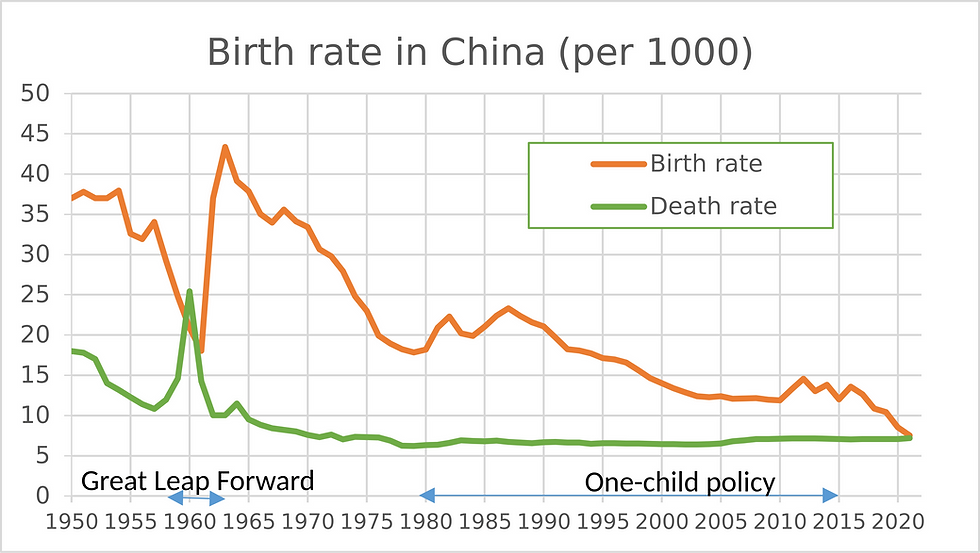
Perhaps no state in modern history has intervened in human reproduction as extensively as the People’s Republic of China, yet few reversals of reproductive policy have been as visibly ineffective as Xi Jinping’s pro-natalist turn. The country’s population fell for a fourth consecutive year in 2025 as the birthrate plunged to another record low despite the introduction of a raft of birth- and family-friendly subsidies and measures since the one-child policy officially ended in 2016. This article argues that China’s current fertility crisis is best understood as a failure of asymmetric reproductive governance: the long tail of “China’s longest campaign” reveals that the unforeseen consequences of the party-state’s well-honed capacity to suppress births through coercively applied administrative controls has undermined its ability to now encourage births. The one-child regime was not merely coercive: it was socially transformative, resulting in a neo-familist, high-investment, “low fertility trap” of the party’s own making, and from which it is unlikely to escape.
Shortly before the Chinese New Year, a Uyghur comedian, widely known as Xiao Pa, complained in a Weibo post that she had been bedridden for two days and running a high fever. “Suddenly it hit me,” she quipped, “that if I had a husband and kids, I would be dragging myself out of bed, clinging to the wall just to cook for them.”[1] Two weeks later, on February 27, the official Weibo community observer "Weibo Hero" [@围脖侠] announced that the account "Xiao Pa Doesn't Welcome Guidance" had been suspended, “in accordance with the requirements of China’s Cyberspace Administration’s special campaign ‘A Clean and Bright Online Environment for the 2026 Spring Festival.’” The stated reason for the decision was that Xiao Pa’s comment had “incited gender antagonism and had created anxiety about marriage and childbirth in violation of the relevant laws and regulations and the requirements of the aforementioned special campaign.” Weibo Hero went on to “urge all users to refrain from deliberately linking gender issues, creating group hatred, or establishing a confrontational persona when participating in public discussions.”[2]
The silencing of Xiao Pa—whose full name is Paziliyaer Paerhati [帕孜力亚尔·帕尔哈提]— sparked indignation from Weibo users. Many noted that her comment simply reflected the norm of gender imbalance common in most households; a few others further criticized Weibo censors for stamping out an innocuous joke while ignoring the proliferation of violent and misogynistic content online.[3] A February 24 tweet reporting the incident by Teacher Li [@whyyoutouzhele] on X, a platform that is banned in China, garnered hundreds of reactions from users who responded in Chinese. One X user wryly commented on Xiao Pa’s complaint: “This contradicts the emperor's policy of encouraging childbirth. The emperor is anxious, and the eunuchs even more so.”[4]
Indeed, the vigorous muzzling of Xiao Pa reflects more than mere anxiety about demography on the part of the central leadership. Seven months earlier, in May 2025, the State Council Information Office White Paper on “China’s National Security in the New Era” elevated plans “to improve the population service system covering the entire population and the entire life cycle, to perfect the fertility support policy system and incentive mechanisms, and to promote the construction of a fertility-friendly society” directly into the country’s new national security strategy.[5] In March 2025, Premier Li Qiang’s annual government work report at the National People’s Congress flagged, for the first time, the government’s promise to provide childcare subsidies [育儿补贴] and “integrated childcare and early childhood services” [托幼一体服务] to all who needed them, signaling the seriousness with which Beijing views the current demographic crisis.[6] By the end of the year, the government had purportedly allocated 100 billion yuan for childcare subsidies, of which 90.4 billion yuan came directly from central government coffers.[7]
Yet, despite these strenuous pro-natalist inducements, China's population fell for a fourth consecutive year in 2025, with registered births dropping another 17 percent to 7.92 million (down from 9.54 million in 2024), hitting the lowest number of births since records began in 1949. In fact, as Yi Fuxian, a senior scientist at the University of Wisconsin-Madison observed, births in 2025 were “roughly the same level as those in 1738, when China's population was only about 150 million,” despite a commitment from Beijing to nearly double its spending on “fertility support policies” that will cost an estimated 180 billion yuan (or USD25.8 billion) this year.[8]
The Chinese experience with population management over the course of the reform era thus poses a puzzle. As is well-known, beginning in 1979–80, China built and vigorously implemented one of the world’s most intrusive systems of reproductive governance, a regime so successful at achieving its aims that Chinese officials repeatedly bragged about having prevented 400 million births since its implementation.[9] Supporters of the “one-child policy,” dubbed “China’s longest campaign” by Tyrene White,[10] claim that the anti-natalist measures contributed to the country’s post-1978 rapid and sustained economic boom. Chinese government officials showcased the success of the birth-control program at international meetings by arguing that it had contributed substantially to global efforts to curb greenhouse gas emissions, producing a cumulative reduction of 1.3 billion tons of carbon emissions by 2005, thereby claiming credit for having contributed mightily to global well-being.[11] But, perhaps ironically, it was the stark statistical evidence of the campaign’s “success” recorded in the 2010 census results—specifically, the extent of the sex ratio imbalance among younger cohorts alongside the rapid aging of the country’s population—that eventually prompted Beijing to reverse course, announcing first a universal “two-child policy” in October 2015, and then other broadly pro-natalist measures in quick succession. The shift initially appeared to boost total births by 2 million in 2016 to 18.5 million; however, total births fell again in 2017 and 2018, to only 17.2 million and 15.23 million, respectively.[12] After Beijing adopted its “three-child policy” and other supportive policies in 2021, the country in January 2023 recorded negative population growth for the first time in six decades, marking its first total population decline since 1961, the last year of the Great Leap Forward famine.[13] Thereafter, despite a host of additional pro-natalist inducements, China’s birth rate continued to collapse: the 2025 birthrate was markedly less than one-half of what it had been in 2016, the first full year of the new “two-child policy.”[14]
Why has the contemporary party-state been flatly unable to produce even a modest durable recovery in births? This article argues that Xi’s pro-natalist turn has failed because the well-honed capacities of the post-Mao Chinese state remain much stronger at prohibition and significantly weaker at welfare provisioning. The “one-child policy” dovetailed with the evolving broad administrative repertoire of the Dengist party-state because it relied upon objects that either were, or could be made, legible: quotas, benchmarks, permits, surveillance, sanctions, and the cadre responsibility system. Pro-natalism, by contrast, fails because its success depends largely on a range of actors whose incentives diverge from those of the Center: local governments, employers, households, and individuals. Furthermore, the new pro-natalist policies are costly, and fiscal responsibility for underwriting them falls on local governments at a time when their budgets are already overstretched due to the ballooning debt and the slowing growth. Private employers are facing razor-thin profit margins and, in some sectors, “involutionary competition” [内卷式竞争][15] that pushes the sale price of goods below the cost of production, making generous family leave policies unaffordable. Finally, households and individuals themselves have been fundamentally altered since 1980: the one-child system normalized small families, while the simultaneous process of marketization created intense educational competition, rising housing costs, and privatized much of the care work that steadily increased the expected cost of child-bearing and child-rearing. The result is that the party-state under Xi now confronts a social order that represents the cumulative outcome of its own earlier policy “successes”— market reform, restricted fertility, and changing household strategies have arguably caught China in a “low fertility trap” [低生育率陷阱][16] largely of its own making. In other words, the party-state under Xi is now trying to undo preferences, norms, and expectations that its own previous vast social engineering experiment had created and then helped to entrench.
A Genealogy of the One-Child Policy
The onset of the reform era in China was marked by the introduction of two vast initiatives that were inextricably linked for the early Dengist leadership: the pursuit of socialist modernization through an ambitious program of market reform, and the fundamental reshaping of the Chinese population into a mobilized mass of modern citizens. As Greenhalgh and Winckler argue, “[a]ll of the PRC’s main leaders have regarded the size and ‘backwardness’ of China’s population as the fundamental point of departure for development strategy.”[17] In 1979, within months of the end of the historic Third Plenary session of the party’s Eleventh Central Committee that adopted “reform and openness” [改革开放], a group of China’s top scientists announced that if the country were to achieve Deng’s goal of a per capita GDP of US$1,000 by the year 2000, China’s total population would need to be contained within 1.2 billion.[18] A team of rocket scientists, led by Song Jian of the Ministry of Aerospace Industry, at the time relied upon control theory and newly available computer-assisted calculations to arrive at two sets of projections. The first estimated an “optimal,” stable population size for China to achieve one hundred years in the future, given ideal levels of economic development, natural resources, and the achievement of an ecological balance; the second set estimated what population policy the nation would require in 1980 in order to achieve its “optimal population” one hundred years hence. The group concluded that in order to meet Deng’s target, an official birth limit of one child per family would need to be imposed on all couples of childbearing age.[19] Anything other than minimal levels of reproduction, the group argued, “would exacerbate the population crisis and delay the arrival of Chinese modernization,” a finding that framed the issue as a “virtual crisis” that compelled swift and decisive action.[20]
However, there was in fact little empirical evidence to support the declaration of a population crisis in China in 1980, as the birth rate had already dropped significantly by that time. In 1965, Mao complained to journalist Edgar Snow that rural women were not making sufficient use of contraception; shortly thereafter, Premier Zhou Enlai proposed the first national population control target, aiming to reduce the annual population growth rate from 2.7 percent to 1 percent by the end of the century.[21] In 1971, Mao repeated his earlier complaint about low uptake of contraception by rural couples.[22] The State Council therefore made reducing the population growth rate to 1 percent in cities and 1.5 percent in rural areas by 1975 part of its Fourth Five-Year Plan: and, by 1974, fertility in urban China was already just below replacement, at 1.98. One year later, a new goal was set, aiming to further reduce population growth rates to 0.6 percent in the cities and 1 percent in the countryside.[23] The campaign slogan “later, longer, fewer” (晚, 稀, 少) was popularized, promoting later marriage, longer spacing between births, and fewer overall births. This was soon replaced with a new slogan—“one is not too few, two is enough, three is too many” [一个不算少,两个正好,三个多了]—in the mid-1970s. Statistical evidence at the time demonstrated that China’s total fertility rate had dropped by more than one-half, from 5.8 in 1970 to 2.8 in 1977, indicating that most of China’s fertility transition had been successfully completed during the 1970s, well before China’s one-child policy was enacted.[24]
Why, then, was the “virtual crisis” of future overpopulation so readily accepted by the Dengist leadership? By some accounts, the imposition of an even more restrictive birth control program—from “soft birth control” to “hard birth planning”—was driven chiefly by Beijing’s desire to increase the per capita economic growth rate,[25] and it was further legitimated by a high-modernist technocratic vision to raise the “quality” [素质] of the general population, “a political decision based on little understanding of demography and society.”[26] Crucially, initial implementation of the “one-child policy” failed: its imposition was not only not followed by further decreases in fertility over those already achieved by the end of the 1970s, but, after an initial drop in 1980, it was followed by a rebound that saw birth rates shoot upwards before fluctuating for most of the remainder of the decade. In fact, by 1982, China’s birth rate surpassed the 1978 level by more than 25 percent.[27] According to a recent study, the “one-child policy” only began to be effective at reducing birth rates in the early to mid-1990s,[28] once the state had reclaimed its coercive capacity that it had lost over the rural population after de-collectivization and the disbanding of the communes almost two decades earlier.[29]
Although the two policies are not often linked in Western historiography of the period, adoption of the Household Responsibility System and imposition of the “one-child policy” roughly coincided in two very different policy arenas, and they were frequently interwoven in official policy documents and local histories of the period. For instance, a 1982 directive, jointly issued by the party Central Committee and the State Council on strengthening family planning, frankly admitted that “family planning work has encountered many new situations and problems; some of the original methods are no longer suitable, and in some places, a laissez-faire attitude has emerged”:
After implementation of the production responsibility system in rural areas, farmers demanded to [be allowed to] have more children, especially boys, believing that with improved living standards, having more children was acceptable, as it would increase the labor force and allow them to receive more farmland under their responsibility.[30]
Numerous local gazetteers note this phenomenon, recording a popular ditty that circulated in rural communities at the time: “With the contracting of production to households, wives’ bellies grew larger, and no one could control it.”[31] Whereas Mao-era methods of inducing grassroots compliance with family planning in many areas of the countryside frequently relied upon a combination of normative (propaganda, education) and remunerative (ubiquitous inexpensive birth control) measures,[32] in early 1979, Deng informed the Politburo that legislation, alongside more stringent coercive measures, would be required to control population growth. At the same time, birth work was moved from the national health bureaucracy and reoriented in the direction of economic planning, creating both a new institutional logic behind birth planning and continuous routine technical interventions by state agents, backed by coercive legal enforcement as well as by standardized sets of rules and proceedings.[33]
The ranks of the Deng-era state family planning bureaucracy, which was initially established as an independent ministry-level governmental branch in 1981, quickly matured into an institutional behemoth. By 2005, the system had spawned a total of 82,350 offices/agencies that employed some 508,713 administrative and professional staff nationwide. In addition, a designated 1.2 million grassroots cadres working at the neighborhood and village levels were tasked with carrying out the state’s birth control and family planning agenda. They were partly overseen by an additional 6 million group leaders, and a further 94 million members of organizations affiliated as Family Planning Associations.[34] Implementation of the “one-child policy” in rural China beginning in the 1980s has been credited with facilitating greater bureaucratic penetration that decreased transaction costs for frontline state agents and that increased their social embeddedness in ways that helped them collect information, boost administrative legibility, and thereby significantly enhance the capacity of the authoritarian reform-era state.[35] When the hard-stop “one vote veto” [一票否决] over local birth planning targets was added to the cadre evaluation system in 1991,[36] the vast juggernaut of institutionalised coercive state power became brutally efficient at suppressing birthrates, and, ultimately, at reshaping the human population on the national level.
The Brave New World of “Inverted Families”
But the hardening implementation of the “one-child policy” during the 1990s did more than merely slash birthrates: alongside abandonment of the institutions of collective life, it fundamentally transformed Chinese society. As the reform-era state withdrew from the provision of social welfare, individuals faced rising competitive pressures in an increasingly marketized, precarious, and risky social environment, forcing younger cohorts to turn back to their parents and families for support. By the early 2000s, as a direct result of the hardening of the “one-child policy” and circulation of a new national discourse on improving “population quality” [人口素质], the traditional, parent-centered household model was literally turned “upside down”: the new “inverted” family structure shifted authority from the eldest to the youngest; and care, resources, and attention flowed downward, prioritizing the “quality” [素质] of the one child’s wellbeing and education. Amidst the rising competitive pressures of a rapidly marketizing society, families increasingly adopted a “4-2-1” multi-generational household model involving a married couple comprised of two singletons and their one child, with four parents/parents-in-law in a supporting role. During the first decade of the new millennium, the one child of the third generation (the “precious little emperor”) became the new locus of “double singleton” (双独家庭) family life, with collective care and material resources flowing downward to the third generation.[37] Chinese sociologists and demographers predict that 35–40 percent of urban families will conform to the “4-2-1” intergenerational model over the course of the next fifteen years.[38] Under the aegis of state-led neoliberal modernization during the 1990s and 2000s, this dynamic of “neo-familism” shifted the primary focus of collective family life from glorifying the ancestors to enabling the grandchildren, a complete inversion of traditional family values.[39]
Given the high parental expectations of upward mobility for their only child, “quality” childrearing in China rapidly became both increasingly consumer-oriented and extremely expensive. In the context of deepening marketization and spreading consumer culture, particularly in China’s first-tier cities, “the project to create the perfect child became a fixation of parents and the wider society alike.”[40] Upwardly mobile urban parents not only invest heavily in their children’s development by purchasing professional educational services but also actively pursue class-coded lifestyles for their children through the adoption of consumption patterns.[41] One study of thirteen Beijing families, carried out between 2010 and 2013, found that twelve of them sent their only children to private pre-schools that cost an average of 2,500 yuan per month, at time when the average monthly wage of the capitol’s working population averaged 4,672 yuan. Other educational expenses, such as extracurricular activities and private tutoring, added an average of another 1,500 yuan per month. Parents with more resources at their disposal chose designer clothing and organic food for their singletons.[42] Another large-scale ten-city survey in 2013 found that families with children between the ages of 3 and 6 spent an average of 1,455 yuan per month on pre-school education, with wealthy families spending an average of 2,584 yuan per month, approximately 18.17 percent of the family income. For the less wealthy families, pre-school education consumed nearly 35 percent of their monthly incomes.[43] In 2004, a study of Shanghai families with children up to 16 years old found that the annual cost of raising a child at the time was between 13,000 and 19,000 yuan, an amount that represented between 39 and 51 percent of total household expenses; tuition for higher education added another 27,000 yuan.[44]
Two decades later, in 2024, those costs had soared even higher. According to the “China National Fertility Expenses Report 2024” [中国生育成本报告2024版], the average cost of raising a child to the age of 17 reached an approximate total of 538,000 yuan—more than 30,000 yuan per year—while per capita disposable income was only 41,314 yuan. Therefore, the cost of raising a single child by 2024 typically required more than the salary of a single parent working full-time. Tuition and educational fees made up more than 50 percent of those expenditures, in part because the competitive pressures of the labor market in China have generated what some commentators are recognizing as an “arms race” [军备竞赛] in education, beginning in primary school. Extracurricular tutoring in subjects like math and English, even with the high levels of government suppression following the July 2021 “double reduction” of burdens policy [“双减”政策] , continues via vast underground markets, serving as an “invisible whip” [看不见的鞭子] driving parents to pour their family incomes into educational expenses for their minor children to avoid their falling behind.[45]
Reversing Course: Too Little, Too Late?
By the dawn of the new millennium, the longer-term costs of the “one-child policy” were becoming evident, but central leaders were slow to respond. When the 2000 population census recorded a total fertility rate of only 1.22, experts expressed considerable “shock” [震撼] and “confusion” [困惑], but central officials dismissed this rate as an undercount based on an assumed underreporting of births. However, demographers and sociologists from leading population research institutes in China formed a research team in 2001 in an attempt to warn the central leaders of the dire consequences that were already becoming clear. In the view of some members of the expert panel, a total fertility rate of below 1.5 signaled that the country had already entered a “low fertility trap” from which it might not be possible to escape.[46] Although the experts themselves were not fully in agreement regarding the reliability of the 2000 census data, they nonetheless formulated a series of collective appeals to Beijing urging a relaxation or an end to the one-child policy, first in April 2004 and then again in January 2009.[47] Their appeals, however, apparently fell on deaf ears.
When the 2010 census demonstrated that the total fertility rate had in fact dropped below 1.4, concerns about China having entered an endemic, self-reinforcing [自我强化] “low fertility trap” increasingly entered the public sphere. Just as worrying, however, was the worsening sex imbalance: one reading of the 2010 data found that the total number of “missing girls” had risen from 8.5 million in the 2000 census to over 20 million in 2010.[48] The modest measures put in place by the central government after the census, like the banning of prenatal sex-determination technology, had little impact, with sex ratios of cohorts born after the 2010 census remaining at 118 males to 100 females, or higher.[49] By 2014, China’s pool of “surplus men” was estimated to be between 20 and 40 million.[50]
Just a few months earlier, in November 2013, Beijing had sufficiently softened its position to permit a partial policy relaxation that allowed couples to have a second child if one parent was a singleton—the so-called “single two-child” policy [单独二孩政策]. Surprisingly to those central officials who had feared that any softening of the restrictions would result in a dramatic uptick in new births, by August 2015 only 15.4 percent of eligible couples had actually applied to have a second child. In October 2015, on the heels of a third urgent collective appeal from the expert panel, a decision was made to allow all couples to have two children and to implement a “universal two-child policy” [全面两孩政策].[51] But birth rates continued to plummet. When the definitive end of the “one-child policy” finally arrived in 2016, by the estimation of many, it did so “at least a decade later than it should have ... because of leaders who have made population control part of their political legitimacy and a bureaucracy that has grown increasingly entrenched in the course of policy enforcement.”[52]
Some local governments took an early lead in introducing bolder pro-natalist measures. At the provincial level, in June 2018 Liaoning rolled out an ambitious Provincial Population Development Plan (2016–2030) [辽宁省人口发展规划(2016–2030年)] that included income-tax breaks and education subsidies to encourage more births. A few days later, the Shaanxi Provincial Bureau of Statistics released its Population Development Report 2017 [陕西省2017年人口发展报告], recommending the introduction of subsidies and rewards for childbirth and enhancements to maternal and child healthcare. In August, Hubei’s Xianning municipality introduced a comprehensive two-child policy, encouraging mothers of two or more children to extend their maternity leave to six months and vowing to reimburse expenses and to pilot flexible work arrangements. A lengthy 2018 People’s Daily article reporting on these measures asserted: “In an era of low fertility intentions and high fertility costs, childbirth is not only a personal matter but also a major issue concerning the long-term stability of the country.”[53] Some localities eschewed the “carrot” for the “stick,” restricting access to contraception and abortion: Jiangxi province reissued guidelines outlining the conditions under which women were permitted to seek abortions, including a requirement that women who are more than 14 weeks pregnant must obtain three signatures from medical personnel before applying to terminate a pregnancy.[54] Other localities have instituted a practice of insisting that couples seeking a divorce first submit to answering a set of quiz questions: the more the married couple professed to know about each other—like their spouse’s birthday or favorite food—the less likely that the local authorities would quickly approve their petition for divorce.[55]
After the Seventh National Population Census revealed that China's total fertility rate in 2020 was barely 1.3, Beijing quickly launched a universal three-child policy, and thereafter it consistently emphasized improvements to supporting measures for the national fertility policy.[56] Local governments responded to the call, with 23 provinces offering subsidies ranging from 3,000 to 60,000 yuan for residents giving birth to a second or third child, to be distributed in monthly, annual, or lump-sum payments.[57] In 2023, the State Council provided localized operational guidelines designed to encourage provinces and municipalities to experiment with tailored birth and family support programs. The following year, the General Office of the State Council released “Several Measures on Accelerating the Improvement of the Birth Support Policy System and Promoting the Construction of a Fertility-Friendly Society,” more commonly referred to as “The 13 Measures,” a series of targeted pro-natalist interventions designed to “create a truly fertility-friendly environment” by addressing a work-life balance, child-care costs, housing burdens, educational pressures, and gender equity.[58]
Just as the original announcement of the “one-child policy” came in the form of an open letter addressed to party members in 1980, many of these pro-natalist efforts have been focused on party members. For example, in September 2016 the Department of Health and Birth Planning in Hubei’s Yichang municipality posted an open letter on its website, calling on all party and Communist Youth League members in Yichang to lead the way in having a second child.[59] A November 2023 report on Lukou community, in Xiangtan’s Yutang district, explicitly “urged party members and cadres to effectively publicize, guide, take the lead in implementing, and consciously carry out the country's optimized birth policy” in order to contribute to long-term balanced population development.[60] More recently, in July 2024, the municipal health commission in Fujian’s Quanzhou municipality produced an internal memo that was leaked online, stating that “party members, cadres at all levels, state-owned enterprises, and public institutions should take the lead in implementing the three-child policy.”[61]
Reactions from the private sector have been more mixed. A handful of private enterprises have vigorously supported the party’s new pro-natalist turn. In 2018, Ctrip—then the world’s second-largest online travel company after Priceline—announced that it would begin subsidizing the cost of freezing the eggs of some of its managers. Jane Sun, Ctrip CEO, said the company was chiefly acting out of a sense of social responsibility, but it was also responding to the potential for economic harm if China’s demographic decline were to worsen.[62] In other cases, however, employers have resorted to more coercive measures: in February 2025, Shandong Shuntian Chemical Group issued a notice requiring single employees between the ages of 28 and 58 to either “establish a career, start a family, and produce a child” or face staged penalties and eventual dismissal if they failed to marry within three quarters. Employees who did not marry and produce offspring were sternly warned that they were failing to uphold “loyalty, filial piety, benevolence, and righteousness” [忠孝仁义].[63] After an upswelling of public complaints, the Yinan County Human Resources and Social Security Bureau intervened, claiming that the notice violated the Labor Law and the Labor Contract Law, ordered an immediate stop to the policy, and it issued a rectification order against management; the company later said it revoked the notice.[64] By contrast, a more commonly reported workplace phenomenon has been the imposition of various restrictions on female employees who might be planning future births and therefore seeking paid leave or the extension of other employee benefits. Some employers have instituted “queueing for childbirth” [排队生育] rules, in which employers attempt to ration when their female employees may become pregnant. A 2025 Shanghai Xuhui District Women’s Federation legal-education post in The Paper [澎湃] cited the example of a hospital with nearly 200 female nurses that limited each department to no more than three simultaneous pregnancies. The Women’s Federation post was unequivocal in response: employers cannot require women to “queue for childbirth,” thereby unlawfully restricting reproductive rights. It further advised that employers who impose such a rule would be subject to mediation, arbitration, litigation, and administrative correction by labor authorities,[65] although discussions on social media as well as academic studies suggest that discrimination by employers against women of childbearing age remains widespread.
Perhaps no business owner in China has been more engaged with the Xi administration’s pro-natalist turn than Liang Jianzhang, founder of Ctrip.com, who co-authored a widely disseminated article outlining measures for addressing China’s demographic decline. In addition to calling upon the government to provide families with multiple children with subsidies of 10,000 yuan per child, reductions in the personal income tax and social security contributions, waiving land price payments for the purchase of family homes, and investing in the construction of approximately 100,000 childcare facilities, Liang has publicly called out the prevalence of anti-natalist views online:
Anti-marriage and anti-childbearing sentiments have become rampant on various social media platforms and self-media. Statistics show that on major social media platforms, comments opposing childbirth overwhelmingly outnumber those supporting it by a margin of 10 to 1. Phrases like “not marrying or having children guarantees peace of mind,” “not bearing children is a form of kindness,” and “not having children means having no Achilles heel” have become commonplace among the younger generation.[66]
In October 2024, Liang and his co-author, Huang Wenzheng, entreated the government to work together with social media platforms and various media outlets to “cultivate positive views on marriage and childbearing and to create a childbearing-friendly social atmosphere.”[67] The silencing of Uyghur comedian Xiao Pa earlier this year serves as one recent example of this policy in action.
The Micropolitics of Refusal
The myriad pro-natalist policies introduced since 2016 have not only had little discernible impact on China’s rapidly declining birth rate but have also frequently served as targets of public scorn and derision. Shortly after the May 31, 2021, meeting at which the Politburo approved the “three-child policy” (held just before China's 71st Children's Day,) Xinhua News ran an article entitled, “The Three-Child Policy is Coming: Are You Prepared?” [三孩生育政策来了, 你准备好了吗?] to which it appended a poll. The overwhelming majority of respondents (90 percent) chose “not considering it at all” [ 完全不考虑]; almost none selected “ready—can't wait” [准备好了迫不及待], “it’s already on the agenda” [已提上日程], or that they were still undecided [犹豫中很多问题带考虑的].[68] Although the poll and the derisive comments that followed were quickly removed from the Xinhua news report, more scientific poll efforts likewise revealed low levels of interest among younger cohorts toward either marriage or childbearing. According to a large-scale, with over 36,000 respondents, 2023 national survey of college student views on marriage and childbearing conducted by a team from Huanggang Normal University, the shares of college students who do not plan to marry and who do not plan to have children were 45.35 percent and 54.21 percent, respectively.[69] More recently, on October 30, 2024, the National Health Commission’s official “Healthy China” [健康中國」WeChat account published a “popular science” [科普] piece entitled “Four Major Benefits of Childbirth for Women” [女性生孩子的四大好處], debunking the apparently popular myth that “pregnancy makes you stupid for three years” [一孕傻三年]. Experts cited in the article claimed that pregnancy not only increases the “gray matter” in women’s brains and makes them “smarter” but also relieves menstrual cramps, reduces uterine fibroids, and prevents certain kinds of tumors. However, online bloggers raced to point out that these claims are unscientific, contain misleading statements, and are intentionally deceptive; some netizens also commented that "after the COVID-19 pandemic, it is impossible to trust experts anymore” [新冠疫情後無法再相信專家的話] and that “they will do anything to encourage childbirth” [為了催生無所不用其極]. The article was quickly deleted and removed after sparking discussion and criticism.[70]
New announcements of the pro-natalist subsidies being rolled out by local governments are likewise frequently mocked online, where they are derided as being equivalent to a “50 yuan coupon for a Lamborghini” [兰博基尼的50元优惠券],[71] spawning online discussions about the meager size of the subsidies relative to the costs of child-rearing (“You get 10,000 for having a child, but you save a million by not having one”).[72] Other reactions that went viral on Chinese social media include one from a netizen who quipped “Is it because Rolls-Royces are subject to purchase restrictions that I don't buy three?” Another observed: “Two only children getting married now have to take care of four elderly people and three children, and they still have to work 996 (9 am to 9 pm, 6 days a week). Even the donkeys in the production teams were not used like this.”[73]
Although the “black hand” of “extreme feminist ideologies” circulating in contemporary China has frequently been blamed for population decline by official think- tanks, economists, and demographers,[74] it is clear that the actual picture is not only far more complex but also at least partially a product of the one-child policy itself. One 2024 study that relied on Chinese Social Survey data on over 2,300 respondents between the ages of 18 and 35 confirms that sibship size positively predicts fertility intentions for the vast majority; but, perhaps surprisingly, this relationship is significantly mediated by trust in local governments, which have shifted the burden of social welfare provisioning onto families in the reform era. Respondents with more siblings, whose parents had responded negatively to the one-child policy, not only evidenced lower trust in local government, but also expressed lower fertility intentions themselves, especially among those respondents who were more educated. It concludes that local governments seeking to ensure the success of the pro-natalist policies must first improve their credibility because trust shapes how receptive young adults will engage with the fertility policy.[75] Relatedly, in her 2023 study of 63 women who grew up in rural Fujian during the 1990s, Qian Liu found that they were profoundly shaped by the traumatic memories in which the fear of being caught, separated from their parents, and locked up had dominated their childhoods at the height of the “one-child policy.” Not only did the vast majority of her informants regard that policy as utterly lacking in moral legitimacy, but Qian Liu also found that they engaged in colluding to bypass, evade, and resist the state and its policies more than two decades later.[76] In other words, the party-state’s vigorous efforts to render reproduction more legible simultaneously generated the very conditions under which villagers relied on each other to make it—and themselves—less legible. Finally, new research on the impact of “sibling absence” on China’s “one child” generation finds that the concentration of parental resources and lack of sibling socialization has resulted in higher individualism, weaker authoritarian beliefs, and lower political interest among adult singletons. This manifests in a generalized aversion to duty-based participation—forms of political engagement anchored in internalized civic obligations—rendering these singletons highly resistant to calls from officials to tailor their childbirth plans with a view towards the long-term stability of the country.[77]
A Pyrrhic Victory for High-Modernist Hubris
The one-child regime was not merely coercive; it was socially transformative. In interaction with other post-1978 market reforms, it compressed family size, normalized quality-over-quantity childrearing, and shifted management of vast welfare needs—education, care, and old-age risks—increasingly to families. The result was an inverted neo-familist, high-investment, low-fertility equilibrium that the Xi-era raft of pro-natalist policies has struggled to undo. The cautionary tale of what has become contemporary China’s “low fertility trap” has strong resonances with what James C. Scott once recognized as a “high modernist” fiasco. In Seeing Like a State: How Certain Schemes to Improve the Human Condition Have Failed, Scott documents the methods upon which states have relied to render society “legible”—by counting, measuring, taxing, and controlling—through techniques like enumeration, mapping, census-taking, and the imposition of standardized surnames. In all of Scott’s cases, the totalistic “aspiration to the administrative ordering of nature and society”[78] was inspired by a hubristic, modernistic self-confidence.
Likewise, the Deng-era leadership, driven by high-modernist hubris, leapt into a vast experiment in large-scale social engineering, and it imposed its neoliberal modernizing vision on a civil society that was steadily eroded and brought under its control, and then ruthlessly colonized after 1989. The party-state, as Deborah Davis observes, succeeded over the course of the reform era in “alternating among the roles of social engineer, administrative regulator, and legal referee as it recalibrates the degree of direct control over citizens' personal lives.”[79]
China’s present fertility dilemma resembles a classic Scottian cautionary tale, up to a point. The one-child regime was not a simple high-modernist failure: it was an intrusive, brutal, and, in many respects, effective project of social engineering that sowed the seeds of its own demise. When its longer-term consequences became increasingly incompatible with the party-state’s later pro-natalist goals, what the Beijing leadership has by now realized is that its earlier hubris has constructed a low fertility trap from which the country may never escape. What Xi’s leadership now confronts resembles less the collapse of an unreadable plan than the afterlife of a policy that succeeded in reshaping family structure, reproductive expectations, and household risk strategies, especially once those changes were reinforced by marketization.
About the Contributor
Patricia M. Thornton is Professor in the Department of Politics and International Relations, the Dickson Poon China Centre, and Fellow of Merton College, at the University of Oxford. She is the author of Disciplining the State: Virtue, Violence, and State-Making in Modern China, co-editor (with Vivienne Shue) of To Govern China: Evolving Practices of Power, and many peer-reviewed articles in scholarly journals. She is also former Acting Editor-in-Chief of The China Quarterly. Her research focuses on the Chinese Communist Party, party-building, civil society, and popular protest in transnational China.
Notes
[1] The original text is “发烧在家躺了两天,想到如果有老公孩子的话这会儿应该要扶着墙起来给他们做饭了.” “脱口秀演员小帕因 ‘挑动性别对立、制造婚育焦虑’被禁言,” 观察者网, February 28, 2026, https://archive.ph/5QSqH
[2] The original Chinese texts referred to in this section are, “根据中央网信办关于 清朗·2026年营造喜庆祥和春节网络环境 …挑动性别对立、制造婚育焦虑信息,因违反相关法律法规和上述专项行动要求…也呼吁广大用户,在参与公共议题讨论时不刻意关联性别议题、不制造群体仇恨,不树立引战对立人设,” 江海晚报.“ 小帕不欢迎指导工作, 被禁言,” Sina.com, February 28, 2026, https://archive.ph/RVFq9
[3] Cindy Carter, “Netizen Voices: Why Did Comedian Xiao Pa Lose Her Weibo Account? Oh, I See … She Just Wrote the Truth,” China Digital Times, March 7, 2026, https://archive.ph/fz2TV; Phoebe Zhang, “Chinese Social Media Bans Female Uygur Comic over Marriage Jokes—Sparks Backlash,” South China Morning Post, March 1, 2026, https://archive.ph/xWO9B ; “被指制造婚育焦虑 新疆脱口秀演员小帕被封,” February 28, 2026, https://archive.ph/7oYlh ; “渲染 ‘婚姻恐惧’? 脱口秀女演员小帕被微博禁言,” 德国之声, March 2, 2026, https://archive.ph/RNULb
[4] “这个跟皇上鼓励生育的政策相抵触了,皇上急,太监更急,” @rj80402648, February 24, 2026 (9:32 AM), https://archive.ph/0VfN1
[5] “健全覆盖全人群、全生命周期的人口服务体系,完善生育支持政策体系和激励机制,推动建设生育友好型社会,” 国务院新闻办公室, “新时代的中国国家安全,” May 12, 2025, https://archive.ph/1lLJO
[6] “政府工作报告:制定促进生育政策 发放育儿补贴,” 人民网, March 5, 2025, https://archive.ph/UzPhu
[7] 新华网, “两会新华解码·‘十五五’规划纲要草案, 未来五年‘生育友好’ 将更加可感可及,” March 7, 2026, https://archive.ph/wip/NAZEn
[8] Amy Hawkins, “China’s Population Falls Again as Birthrate Hits Record Low,” The Guardian, January 19, 2026, https://archive.ph/9pD13; Farah Master, “China's Population Drops for Fourth Year as Fewer Babies Born,” Reuters, January 19, 2026, https://archive.ph/zAVnK
[9] The 400 million figure is attributed to the September 2009 claim by Li Bin, then director of the National Population and Family Planning Commission, who announced to Xinhua News Agency that “China created a miracle in world population development by reducing births by 400 million in 30 years.” Zhao Baige, deputy director of the National Population and Family Planning Commission in 2009, repeated this figure at the 2009 United Nations Climate Change Conference in Copenhagen. (溪山梵唱, “4亿中国人是怎么少生的?” 微博, June 3, 2023, https://archive.ph/FKG1p However, the originator of the calculation is also sometimes acknowledged to be former director of the National Population and Family Plantru Commission Zhang Weiqing, who, in 2006, published an article in Qiushi magazine, pointing out that “according to population experts' estimates, by the end of 1998, my country had more than 300 million fewer births; by the end of 2005, more than 400 million fewer births.” See “求是:力控人口规模 中国计生政策应长期保持不变,” Sina.com, October 1, 2006, https://archive.ph/2cvsu A 2015 scholarly assessment debunked the 400 million figure as having “three fatal flaws.” See Martin King Whyte, Wang Feng, and Yong Cai, “Challenging Myths About China’s One-Child Policy,” The China Journal, no. 74 (2015), https://doi/10.1086/681664, pp. 155–158.
[10] Tyrene White, China’s Longest Campaign: Birth Planning in the People's Republic, 1949–2005 (Ithaca: Cornell University Press, 2006).
[11] “In 2007 Su Wei of China’s foreign ministry said that his country’s one-child policy, by reducing the number of births between the late 1970s and the mid-2000s by 300m, had reduced carbon emissions by 1.3 billion tonnes in 2005 (because there were fewer people to consume goods which generated greenhouse gases in their production).” See “The Deepest Cuts: Our Guide to the Actions that Have Done the Most to Slow Global Warming,” The Economist, September 20, 2014, https://archive.ph/HPPeN
[12] Tyrene White, “Policy Case Study: Population Policy,” in William A. Joseph, ed., Politics in China: An Introduction, Third Edition (Oxford: Oxford University Press, 2019), https://doi.org/10.1093/oso/9780197683200.003.0015, pp. 429–430.
[13] 国家统计局, “2022年国民经济顶住压力再上新台阶,” January 17, 2023, https://archive.ph/uIpc1; Albee Zhang and Farah Master, “China's First Population Drop in Six Decades Sounds Alarm on Demographic Crisis,” Reuters, January 18, 2023, https://archive.ph/O9SgN
[14] Liyan Qi, “China’s New Plan to Encourage More Births: $500 a Year,” The Wall Street Journal, July 17, 2025, https://archive.ph/MsUyd ; Amy Hawkins, “China’s Population Falls Again as Birthrate Hits Record Low,” The Guardian, January 19, 2026, https://archive.ph/9pD13; Farah Master, “China's Population Drops for Fourth Year as Fewer Babies Born,” Reuters, January 19, 2026, https://archive.ph/zAVnK
[15] 新华社, “中共中央政治局召开会议 分析研究当前经济形势和经济工作 审议《整治形式主义为基层减负若干规定》 中共中央总书记习近平主持会议,” July 30, 2024, https://archive.ph/U9PzB ; Patricia M. Thornton, “Punching Down: Beijing’s Playbook for Unwinding ‘Involutionary Competition,’” China Leadership Monitor, November 30, 2025, https://www.prcleader.org/post/punching-down-beijing-s-playbook-for-unwinding-involutionary-competition
[16] Wolfgang Lutz and Vegard Skirbekk. "Policies Addressing the Tempo Effect in Low‐fertility Countries," Population and Development Review 31, no. 4 (2005): 699–720.
[17] Susan Greenhalgh and Edwin A. Winckler, Governing China’s Population: From Leninist to Neoliberal Biopolitics (Stanford: Stanford University Press, 2005), p. 2.
[18] White, “Policy Case Study: Population Policy,” p. 420.
[19] Susan Greenhalgh, “Science, Modernity, and the Making of China's One-Child Policy,” Population and Development Review 29, no. 2 (June 2003): 178.
[20] Greenhalgh, “Science, Modernity,” pp. 179–181.
[21] White, “Policy Case Study: Population Policy,” p. 449.
[22] Whyte, Wang, and Cai, “Challenging Myths About China’s One-Child Policy,” pp. 148–149.
[23] Wang Feng, Yong Cai, and Baochang Gu, “How Will History Judge China’s One-Child Policy?” Population and Development Review 38 (Supplement) (2012): 117.
[24] White, “Policy Case Study: Population Policy,” p. 449
[25] Whyte, Wang, and Cai, “Challenging Myths About China’s One-Child Policy,” p. 154.
[26] Wang Feng, Baochang Gu, and Yong Cai, “The End of China’s One-Child Policy,” Studies in Family Planning 47, no. 1 (2016): 84.
[27] After the announcement of the “one-child policy,” the total fertility rate rose for four consecutive years, from 2.75 in 1979, reaching a peak of 2.97 in 1982; it was not until 1991, 12 years after the policy was implemented, that the average number of births dropped to 1.91, below replacement level. 卓憲文, “當年輕人 ‘拒絕生育,’ 他們和他們的後輩,會過得更好嗎?” 外脑, March 6, 2023, https://archive.ph/RWlRP ; Tang Lianzhou and Xu Wenli, “State Retreat: Decollectivization, Land Reform and Fertility Transition,” Social Science Research Network (June 12, 2025), p. 9, https://dx.doi.org/10.2139/ssrn.5286176
[28] Li Hongbin, et al., “Bureaucratic Incentives and the Effectiveness of the One-Child Policy in China,” National Bureau of Economic Research Working Paper 33741 (2025), http://www.nber.org/papers/w33741
[29] Lin Youhong, Pan Wendong, and Erik H. Wang, “Hayek in China: The Effect of Economic Control on Coercive State Capacity,” Social Science Research Network (March 19, 2026), https://papers.ssrn.com/sol3/papers.cfm?abstract_id=6443019
[30] “计划生育工作遇到了许多新情况、新问题, 原来的一些办法有的已不适应,有些地方出现了放任自流的现象…农村实行生产责任制后,农民要求多生、生男孩,认为生活好了,多生几个孩子没关系,孩子多了可以增加劳动力,多分责任田,” 中共中央、国务院《关于进一步做好计划生育工作的指示》,中发〔1982〕11号,1982年2月9日, https://archive.ph/2qlUL
[31] “包产到了户, 老婆大了肚, 谁也管不住.” Lianzhou Tang and Wenli Xu, “State Retreat,” https://dx.doi.org/10.2139/ssrn.5286176, p. 9.
[32] However, as Whyte et.al, note, the “later, longer, fewer” campaign of the 1970s must not be misunderstood as a voluntary birth control effort: it was instead both “coercive and campaign-driven.” “Although not as extreme as China’s 1983 sterilization and abortion high tide following the launch of the one-child policy, birth-control operations (abortions, IUD insertions and sterilizations) shot up several times during the 1970s in association with the campaign to enforce birth limits.” Whyte, Wang, and Cai, “Challenging Myths About China’s One-Child Policy,” pp. 149–152.
[33] Greenhalgh and Winckler, Governing China’s Population, pp. 91, 95.
[34] Yong Cai and Wang Feng, “The Social and Sociological Consequences of China’s One-Child Policy,” Annual Review of Sociology 47 (2021): 597.
[35] Daniel C. Mattingly, “Responsive or Repressive? How Frontline Bureaucrats Enforce the One Child Policy in China,” Comparative Politics (January 2000), pp. 279, 284; Melissa M. Lee and Nan Zhang, “Legibility and the Informational Foundations of State Capacity,” Journal of Politics 79, no. 1 (2016): 118–132.
[36] Li Hongbin, et al., “Bureaucratic Incentives.”
[37] Yan Yunxiang, “Intergenerational Intimacy and Descending Familism in Rural North China,” American Anthropologist 118, no. 2 (2016): 244–257.
[38] Yan Yunxiang, “Introduction: The Inverted Family, Post- Patriarchal Intergenerationality and Neo- Familism,” in Yan Yunxiang, ed., Chinese Families Upside Down: Intergenerational Dynamics and Neo-Familism in the Early 21st Century (Amsterdam: Brill, 2010), p. 6.
[39] Yan Yunxiang, “The Private Life Approach to the Rise of Neo-familism in China,” The Sociological Review 73, no. 4 (2025): 753–770.
[40] Susan Greenhalgh, Cultivating Global Citizens: Population in the Rise of China (Cambridge: Harvard University Press, 2010), p. 68.
[41] Xiao Suowei, “Intimate Power,” in Yan Yunxiang, ed., Chinese Families Upside Down, pp. 150. See also Helen, “抵抗生育的中国千禧一代,” 外脑, July 2, 2022, https://archive.ph/C50Pn
[42] Xiao Suowei, “Intimate Power,” pp. 150–151.
[43] 刘焱, 宋妍萍, “我国城市3-6岁儿童家庭学前教育消费支出水平调查,” 华中师范大学学报 52, no. 1 (2013): 156.
[44] 徐安琪, “孩子的经济成本_转型期的结构变化和优化,” 青年研究, no. 12 (2004): 5.
[45] See, for example,“中国男性是否能独立养家?从经济学角度看,何为劳动供养率?” CriS财经时政漫谈, May 29, 2025, https://archive.ph/70tyP ; 梁建章,黄文政,何亚福, “中国生育成本报告2024版,” 育娲人口研究, February 2024, https://file.c-ctrip.com/files/6/yuwa/0R72u12000d9cuimnBF37.pdf
[46] 王军 , 李向梅, “中国三孩政策下的低生育形势、人口政策困境与出路,” 青年探索, no. 234 (April 2021): 52–53
[47] Thomas Scharping, “Abolishing the One-Child Policy: Stages, Issues and the Political Process,” Journal of Contemporary China 28, no. 117 (2019): 327–347.
[48] Yong Cai , “China's New Demographic Reality,” pp. 382–388; 彭希哲, 胡湛. “当代中国家庭变迁与家庭政策重构,” 中国社会科学, no. 12 (2015): 113–132.
[49] Yong Cai, “China's New Demographic Reality,” p. 388.
[50] Yong Cai, "Chinas Demographic Challenges: Gender Imbalance," in Jacques deLisle and Avery Goldstein, eds., China's Challenges (Philadelphia: University of Pennsylvania Press, 2014).
[51] Wang Feng, Baochang Gu, and Yong Cai, “The End of China's One-Child Policy,” p. 83.
[52] Wang Feng, Baochang Gu, and Yong Cai, “The End of China's One-Child Policy,” p. 84.
[53] “在低生育意愿—高生育成本时代,生育不仅仅是个人私事,也是关系国家长治久安的大事.” 彭训文, “让人们敢生愿生 ‘二孩,’”人民日报, 2018年08月06日, https://archive.ph/0NsZq
[54] Steven Lee Myers and Olivia Mitchell Ryan, “Burying ‘One Child’ Limits, China Pushes Women to Have More Babies,” The New York Times, August 11, 2018, https://archive.ph/7OksG Even more recently, at the end of 2025, Beijing announced a new 13 percent value-added tax [VAT] on condoms and contraceptives—commodities that have been exempt from taxation since China introduced its nationwide VAT in 1993. See Amy Hawkins, “China to Hike Tax on Condoms in Attempt to Boost Falling Birth Rate,” The Guardian, December 18, 2025, https://archive.ph/COrVa
[55] Tiffany May, “Want a Divorce in China? You Might Have to Fail a Quiz First,” The New York Times, May 30, 2018, https://archive.ph/cY0Uc
[56] 王军 , 李向梅 “中国三孩政策下的低生育形势,” p. 53.
[57] 丘也, “生育友好等於女性友好?中國生育「頂層設計」民間遇冷,” 端媒体, November 8, 2024, https://archive.ph/6Hyqr
[58] 国务院办公厅, “关于加快完善生育支持政策体系推动建设生育友好型社会的若干措施,” October 19, 2024, https://archive.ph/G42J4
[59] 彭训文, “让人们敢生愿生 ‘二孩,’”人民日报, 2018年08月06日, https://archive.ph/0NsZq
[60] “路口社区多措并举推进 ‘和谐社会 全面三孩’政策宣传工作,” 岳塘 • 村社新闻, November 3, 2023, https://archive.ph/N2A83
[61] “号召党员干部宣传引导好、带头落实好、自觉执行好国家的优化生育政策,” “党员干部、各级机关、国有企业、事业单位干部要带头贯彻落实三孩政策,” “号召党员干部生三孩,”官方回应!” “号召党员干部生三孩,官方回应!” 大众日报, July 21, 2024, https://archive.ph/C5kh1
[62] Myers and Ryan, “Burying ‘One Child’ Limits.”
[63] The Chinese text referred to in this section is “成家立业,组建家庭,为家庭生贵子.” “不结婚就辞退?山东舜天以“忠孝仁义”限令员工成家 独家回应:已整改并废止所有规定,” 华夏时报, February 14, 2025, https://archive.ph/tqksM ; “单身员工不结婚就离职?最新回应!” 澎湃新闻, February 15, 2025, https://archive.ph/4CsZC
[64] “单身员工不结婚就离职?最新回应!” 澎湃新闻网, February 15, 2025, https://archive.ph/4CsZC
[65] “用人单位可以要求女职工’排队生育’吗?” 澎湃新闻, June 10, 2025, https://archive.ph/SoUnN
[66] “现在各种社交平台和自媒体上反婚反育的言论已经泛滥成灾。有机构统计,在各主要社交平台上,反对生育的评论基本都是以10比1的优势压倒支持生育的评论。像“不婚不育保平安,、 “不生是一种善良”、“不生孩子就没有软肋”之类的言论已经成为许多年轻人的口头禅.” 梁建章、黄文政, “对完善生育支持政策体系最新文件的评论和建议,” 泽平宏观 , October 31, 2024, https://archive.ph/BpJPs . “Not having children means having no Achilles heel” [ ] is an oblique reference to the attempts of local officials to enforce compliance with zero-COVID measures during the pandemic lockdowns by threatening consequences or other punishments against family members of uncooperative residents. In one such well-publicized case, a video surfaced showing a residence committee worker discussing how to deal with noncompliant residents, in which he reveals that “his weakness is actually his son” “他的软肋其实是他的儿子.” “他的软肋是儿子” 疑北京居委会商讨管控民众惹众怒,” 自由亚洲电台,November 26, 2022, https://archive.ph/NTCqt . Another viral case involved a Shanghai resident who, when he was warned that his non-compliance would “affect three generations of [his] family,” retorted that “We are the last generation, thanks.” “这是我们最后一代,谢谢!” “上海男子一句我们是最后一代意外惊爆网络,” RFI, May 13, 2022, https://archive.ph/g1m7N.
[67] “培育积极的婚育观,营造生育友好的社会氛围.” 梁建章、黄文政, “对完善生育支持政策体系最新文件的评论和建议,” 泽平宏观 , October 31, 2024, https://archive.ph/BpJPs
[68] 孫瀾, “三孩政策|「投票結果讓新華社尷尬」 中國社會「民不聊生」?”香港01, June 7, 2021, https://archive.ph/wTbjZ;
[69] As cited in 梁建章、黄文政, “对完善生育支持政策体系最新文件的评论和建议.”
[70] 丘也, “生育友好等於女性友好?中國生育「頂層設計」民間遇冷,” 端媒体, November 8, 2024, https://archive.ph/6Hyqr
[71] 易小艾, 广茉,许七, 张可予, “让女人生韭菜,然后全社会割韭菜,中国生育奖励政策为何没用?” 端媒体, August 31, 2023, https://archive.ph/VpGao .
[72] “生孩子拿一萬,不生孩子省下百萬.” 丘也, “生育友好等於女性友好?中國生育「頂層設計」民間遇冷.”
[73] “我不买三辆劳斯莱斯是因为劳斯莱斯限购吗?” “两个独生子女结婚要照顾四个老人和三个孩子还要996,生产队的驴也不是这个用法.”中国数字空间, “三胎政策,一个错别字为啥那么敏感?” [404档案馆]第3期, June 9, 2021, https://archive.ph/6Hyqr
[74] 易小艾, 广茉,许七, 张可予, “让女人生韭菜,然后全社会割韭菜.”
[75] Zheng Jiansong, et al., “The Mediating Role of Trust in Government in Intergenerational Transmission of Fertility Intentions,” Frontiers in Public Health 12, no. 1338122 (2024), doi: 10.3389/fpubh.2024.1338122.
[76] Qian Liu, “Legal Collusion: Legal Consciousness under China’s One-Child Policy,” Law & Social Inquiry 49, no. 4 (November 2024), https://doi.org/10.1017/lsi.2023.79
[77] Wang Peijie and Zhang Youlang, “The “Missing Sibling” Effect: how China’s One-Child Policy Reshaped Grassroots Voting,” Public Choice (January 2026), https://doi.org/10.1007/s11127-025-01371-5
[78] James C. Scott, Seeing Like a State: How Certain Schemes to Improve the Human Condition Have Failed (New Haven: Yale University Press, 1998), p. 143.
[79] Deborah S. Davis, “On the Limits of Personal Autonomy: PRC Law and the Institution of Marriage,” in Deborah S. Davis and Sara L. Friedman, eds., Wives, Husbands, and Lovers: Marriage and Sexuality in Hong Kong, Taiwan, and Urban China (Palo Alto: Stanford University Press, 2014), pp. 41–42.
Photo credit: Phoenix7777, CC BY-SA 4.0 <https://creativecommons.org/licenses/by-sa/4.0>, via Wikimedia Commons


