“The Patient Labor of Assimilation”: China’s Strategies to Create a New “New Territory”
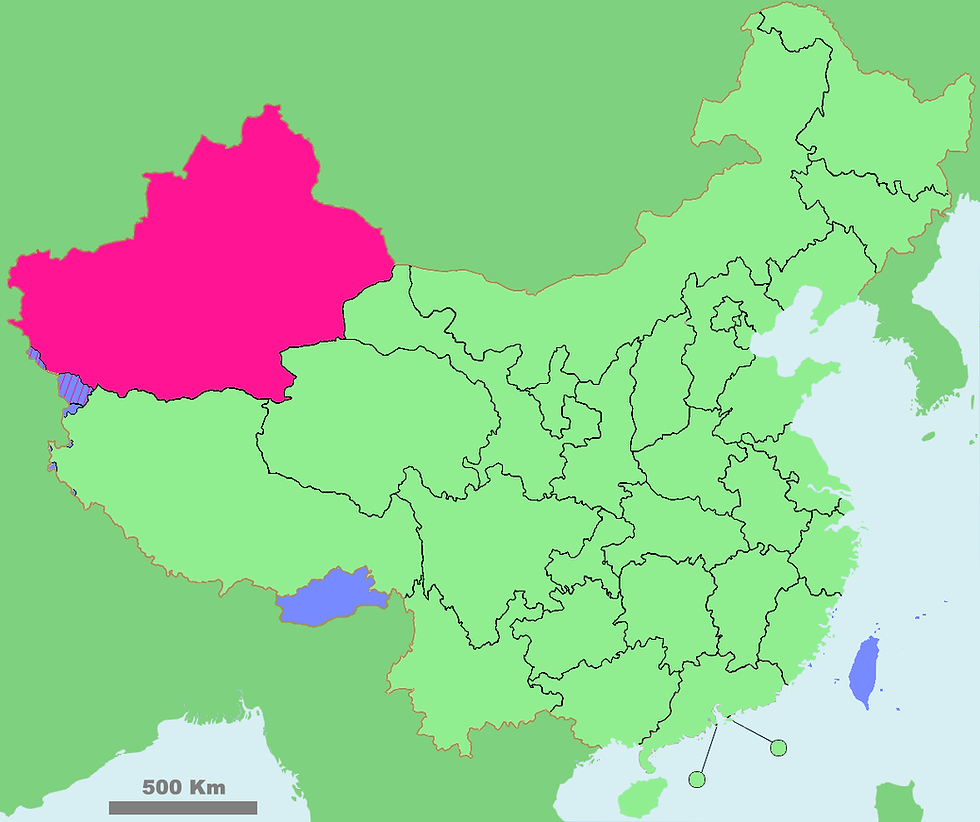
With the so-called re-education camps closed, not only has media attention on Xinjiang waned but a troubling misconception seems to have taken hold: state violence targeting Uyghurs is over. In reality, the party-state’s infrastructure of repression has become more deeply entrenched in the region. Using open-source materials, especially government reports, official county-level blogs, and cadre diaries, this essay demonstrates that long prison sentences have replaced short-term internment, boarding schools increasingly separate Uyghur children from their families, and labor programs continue to relocate hundreds of thousands. These policies aim to weaken Uyghur attachments to their homeland and dismantle their social institutions, reshaping Uyghur identity and remapping the land as specifically Chinese.
In its White Paper “Historical Matters Concerning Xinjiang,” the State Council Information Office of the People’s Republic of China asserts that Xinjiang has been a part of “China’s territory” where many cultures have coexisted since “ancient times” and that by the end of the 19th century, thirteen ethnic groups had settled there.[1] This simplified retelling flattens uneven and contested histories to stitch together a narrative of consistent Chinese contact, while implying continuous dominion. Further, this is a narrative that downplays the geographically specific distributions of these groups, particularly the concentration of Uyghurs in the southern oases of the Tarim Basin. Additionally, the exclusive use of Chinese terms such as “Xiyu” (Western Regions) and “Xinjiang” (New Territory)—the latter affixed to the region in the late 19th century—serves to officially erase local toponyms and ignore the distinct spatial imaginaries they produce. In doing so, the White Paper undermines Uyghur claims of indigeneity, thereby discursively contributing to the party-state’s colonial project.
Despite official narratives that frame Xinjiang as historically multi-ethnic and its people as eternally bound to Chinese culture—and long before these papers were drafted—Uyghur identity itself crystallized over time through local histories, intimate connections to place, and collective life. Anthropologist Jay Dautcher uses the term “chthonic” to describe how Uyghur attachment to their homeland has been perpetuated through shared cognitive maps and embodied social practices.[2] Building on this spatially-centered understanding of Uyghur identity, Darren Byler employs the vernacular term yerlik (yärlik), meaning “native” or “of the place.” Uyghurs use this term to communicate authenticity, belonging to a shared past and future, and their place within imagined transregional Uyghur and transnational Muslim communities.[3] As a Uyghur intellectual from Turpan explained to me: “Uyghur people are linked through social institutions that span outward from mähällä (neighborhood) to jäma’ät (mosque community), to [Friday] mosque, then mazar (sacred shrine), and finally bazaar.” These places and the practices associated with them solidified communal Uyghur identities.
The Chinese Communist Party actively seeks to uproot and remove these local institutions to wither the identities that blossom from them. Although the camps have closed, the party-state persists in efforts to physically relocate Uyghurs through mass imprisonment, assimilationist boarding schools, and state-organized labor programs. These far less spectacular, yet more durable, mechanisms of governance amount to a comprehensive colonial project determined to displace Uyghurs from their homeland.
Mass Incarceration
Mass incarceration has been a key instrument for removing Uyghurs from their communities. During the Chen Quanguo crackdowns from 2016 to 2019, parallel systems of incarceration operated in the region. Media coverage focused primarily on the “camps, or extrajudicial institutions euphemistically referred to in Chinese sources as “transformation through education training centers” (Ch. jiaoyu zhuanhua peixun zhongxin 教育转化培训中心) and “vocational skills [and] education training centers” (Ch. zhiye jineng jiaoyu peixun zhongxin 职业技能教育培训中心), among many other phrases. Operating outside the court systems, detention in the camps was determined by neighborhood (Ch. shequ 社区) and village (Ch. cun 村) administration committees, which sent individuals to “training” (Ch. song pei 送培).[4] Others were held in pre-trial detention centers (Ch. kanshousuo 看守所) where they waited for police to gather “evidence” for their crimes before being sent to camps, in some cases released, or formally sentenced to prison (Ch. jianyu 监狱), often on spurious charges.
Police and public security departments from other provinces who assisted in the region through the “Aid Xinjiang” campaign (Ch. Yuan Jiang 援疆) often reported their experiences in public fora. For example, a law enforcement officer from Jiangxi stationed at Maralbeshi County (Ch. Bachu) Detention Center noted that the facility—built in 2015 to accommodate 1,000 inmates—held 3,695 “endangering state security” (Ch. wei an fan 危安犯) individuals and more than 1,000 female detainees at the height of the “strike hard” period.[5] Zhu Baoping, a police officer from Yangzhou who served in Aqsu, received a commendation for his role in security operations at the 19th National People’s Party Congress—held from October 18 to 24, 2017—during which he aided in the detention of more than 400 individuals.[6] Officers from Shangrao, Jiangxi province described sorting through thousands of detainee dossiers with their Uyghur colleagues at the Yengisar Detention Center.[7] Meanwhile, a police officer named Su Hongtian who was stationed in Keriyä (Ch. Yutian) county reported that the local detention center had as many as 4,000 inmates[8]—the facility’s capacity in 2017 was around 1,000.[9] In a final example, a report from Qizilsu indicates that over 600 farmer and herdsmen party members were either detained, imprisoned, or [re-]educated in government “purification” (Ch. chunjie 纯洁) efforts.[10]
Although it is impossible to ascertain precise incarceration numbers from 2016 through 2019, these social media posts help to substantiate broader estimates. Working with leaked Chinese public security documents indicating that 892,000 individuals from sixty-eight counties were detained in Spring 2018, Adrian Zenz has calculated a 12.3 percent detention rate in counties where non-Han groups were the majority. Extrapolating from these figures, he conservatively estimates that 10 percent of the region’s ethnic minority population—about one million people—had been interned in either a camp, pre-trial detention center, or prison.[11] Independent investigations by the BBC, the Australian Strategic Policy Institute, and Agence France-Presse, which analyzed a combination of satellite imagery and open access government documents, deemed this estimate to be “credible.”[12] Complementing these approximations, individual case documentation provides further evidence of the scale of detention. The Xinjiang Victims Database currently catalogs 60,000 detainees from 2017 onward.[13] Taken together, these sources suggest that the one million—or 10 percent—estimate is plausible but remains unverifiable.
Sometime in 2019, officials closed the transformation through education centers. Based on communications with individuals whose relatives had been detained as well as anecdotal evidence, an independent report from January 2019 estimates that people in the “hundreds, if not thousands” had been released from these facilities.[14] These testimonies align with official statements from the Chinese government. At a July 30, 2019, press conference, then XUAR chairman Shöhrät Zakir declared that “most people [at the centers] had already gone back to society”[15] and later claimed that all “trainees who have participated [in the camps]…have all graduated.”[16]
A period of relaxed policies did not follow the official end of these facilities. Instead, mass incarcerations continued in the formal prison system. Statistics published by the Xinjiang High People’s Procuratorate in February 2022 tally 540,826 prosecutions since 2017; China’s conviction rate is believed to be 99.9 percent.[17] Available sentencing data show that over 99 percent of convictions in 2017 carried sentences of five years or longer, with an average sentence of 9.24 years.[18] Therefore many of those convicted during this period likely remain incarcerated at the time of this writing. Other data are consistent with the scale of this shift: the Xinjiang Victims Database contains over 40,000 records of individuals sentenced or provisionally sentenced since 2017;[19] Human Rights Watch reports that 232,524 people in Xinjiang were formally sentenced between 2017 and 2018 alone.[20] Drawing upon these statistics and limited sentencing samples, a 2025 report conservatively estimates that 459,234 individuals prosecuted between 2017 and 2022 and sentenced to five years or longer remain in custody in Xinjiang.[21] In effect, prisons have replaced extrajudicial facilities as the primary mechanism of mass detention.
Chinese social media further indicate sharp increases in prison sentences as the party-state phased out the camps. In March 2018, the XUAR prison system recruited 699 people, prioritizing applicants from or with strong ties to the region.[22] That same year, Shanxi Prison’s WeChat account praised officer Wang Yongmao for being responsible for over 2,000 “endangering state security” detainees (Ch. wei an fan 危安犯) during his 180-day assignment at Khotan Prison, a time when there was a “rapid increase in the number of inmates” and a “severe imbalance in the officer to prisoner ratio.”[23] In a July 2018 report to fellow officers in Hunan, Li Shuang—who had spent the previous six months working in a Xinjiang prison—described a similar situation in which there was a “continuously decreasing ratio of police officers to prisoners.”[24] Although these reports date to 2018, they remain relevant to this discussion because they correspond to a dramatic spike in long-term prison sentences.
Hearings involving well-known Uyghur intellectuals and cultural icons illustrate how sham prosecutions may underpin many of these cases. Internationally renowned scholar Rahilä Dawut, who disappeared in 2017, was sentenced to life in prison for “splittism” following a secret court hearing; her appeal was rejected by the XUAR High People’s Court.[25] In January 2018, novelist and poet Perhat Tursun was detained and believed to have been sentenced to sixteen years in prison.[26] Three months later, authorities detained pop music star Ablajan Ayup who was subsequently sentenced to eleven years in prison on undisclosed charges.[27]
Boarding Schools
An expanding boarding school system from the primary to senior-secondary levels has extended to children the party-state’s systematic displacement efforts. The foundation for this project was established in fall 2000 when officials inaugurated the Xinjiang Class (Ch. Neidi Xinjiang gaozhong ban 内地新疆高中班, officially renamed the Xinjiang gaozhong ban 新疆高中班 in 2019). Selected by test performance, the first cohort of 1,000 students—80 percent of whom were to be rural and nomadic ethnic minorities—completed their senior-secondary education at one of twelve designated schools in inner China. Since its inception, the Xinjiang Class has enrolled over 150,000 students from Xinjiang,[28] the overwhelming majority being Uyghurs from southern oases. Throughout the course of study—four years until 2019, then shortened to three years—Chinese is the only language of instruction, and religious practice is strictly forbidden. Students may only return home once per year, during summer recess.
Participation has remained voluntary, and the program’s affordability has likely contributed to its high enrollment rates. Prior to the region-wide elimination of high school tuition before the 2015 academic year, the Xinjiang Class was often considerably less expensive than local schools, especially once miscellaneous fees were considered.[29] In contrast, tuition for the Xinjiang Class was calculated on an income-based, three-tier system: families with a government-employed parent paid 900 RMB; farming or single income households paid 450 RMB; and those recognized as impoverished households were not required to pay tuition. It is unclear whether this tuition structure remains in place today. However, even if these fees still exist, state subsidies would offset the fees. For example, students from several counties in southern Xinjiang receive support from host provinces and municipalities to cover the roughly 12,000 RMB per person operating costs, while the XUAR government allocates an additional 2,700 RMB per student each year for transportation, food, medical expenses, tuition, and other fees.[30]
In 2004 Xinjiang authorities introduced a similar boarding school program for junior-secondary students, called the neichu ban (内初班).[31] In its early stages, this XUAR-wide education initiative enrolled elementary school graduates, over 90 percent of whom were ethnic minorities, in boarding schools located in eight cities; the program has since been expanded to thirty-five schools located across eighteen cities. In its first year, yearly enrollment was capped at 1,000 students; by 2017, incoming cohorts rose to 12,000.[32] In 2024, the neichu ban consisted of forty-one schools and admitted 12,930 students.[33] Similar to the curriculum of the Xinjiang Class, neichu ban courses are conducted entirely in Chinese.[34] Most schools only allow these middle-school–aged children to return home once per year for a two-month summer break.[35]
Boarding schools at the primary and junior-secondary levels are increasingly becoming the norm—not the exception—in Xinjiang. In Yengishähär county (Ch. Shule), the Qilu Shule No. 2 Middle School boarded 3978 students in 2024,[36] and in 2025, the Shule Experimental School subsidized nearly 1,300 residential students.[37] In Awat county (Ch. Awati), the Lu Xun Middle School opened its doors in 2022 with funding from the Shaoxing Municipal Aid Xinjiang program, accommodating 1,200 full-time boarding students.[38] In Guma county (Ch. Pishan), officials allocated over 81 million RMB in 2023 for a fourth boarding school. The 33,000-square- meter campus offers teaching buildings, dormitories, a cafeteria, and sports fields.[39] The new school increased the number of boarding school students in the county to 27,569, with 12,070 at the primary level (six to twelve year olds) and 15,499 at the junior-secondary level (twelve to fifteen year olds).[40] With financial assistance from Tai’an city, Yuepuhu No. 6 Middle School also opened in 2023, boarding over two thousand students on its 215-acre campus.[41] In Niya county (Ch Minfeng)—where over 90 percent of registered residents are Uyghur—boarding schools are distinctly prevalent. In 2024, 2,649 boarding students were eligible for financial support—1,333 at the primary level and 1,316 at the junior-secondary level.[42] For some additional perspective, according to a 2025 report on Niya’s education system, the county had 4,812 primary students and 2,170 junior-secondary students,[43] which implies that approximately 28 percent of all primary students and more than 60 percent of all junior-secondary students attend boarding school. These examples demonstrate how boarding schools have transitioned from an option to a central component of the region’s compulsory education.
Strictly-speaking voluntary, decisions about boarding schools are often constrained by structural realities. In many rural areas, schools have been consolidated into boarding institutions leaving families with few practical alternatives. Generous subsidies from multiple levels of government further incentivize participation. Therefore, the dramatic increase in boarding school enrollment is unlikely a reflection of broad community enthusiasm; rather, it may signal a fundamental reorganization of Xinjiang’s educational landscape.
Boarding schools provide an immersive Chinese cultural environment, starting with language. Although the 2023 Ministry of Education document “The XUAR works to actively promote and popularize the common national language and writing system” (Ch. Xinjiang Weiwu’er zizhiqu jiji zuo hao guojia tongyong yuyan wenzi tuiguang puji gongzuo) contains only a vaguely worded call to expand the use of Chinese and not a mandate,[44] evidence from the ground suggests Xinjiang’s schools have largely adopted Chinese as the primary language—and in some cases the only medium—of classroom instruction. A Uyghur senior-secondary student in Kashgar told a Han visitor that schools were the same as in the “interior” (Ch. neidi 内地), with everyone speaking Chinese—even kindergartners.[45] A well-known Han vlogger interviewed primary school-aged Uyghur children on the streets of Kashgar who also stated that Chinese was the only language taught in school. One boy explained to the Han woman that there were no Han students in his school, but his teacher was Han. He added that students only spoke Chinese at school, but it was “ok” (Ch. ke yi 可以) to speak Uyghur at home.[46] However, unlike their non-residential schooling peers—such as the young boy in the vlog—students in boarding institutions do not return to a Uyghur-language environment when classes end each afternoon.[47]
At the most extreme end of this system are children whose parents have been detained. In Qoch township (Ch. Kuoyiqi), Qaraqash county (Ch. Moyu), “most” (Ch. daduoshu 大多数) of the over 450 students at Kuoyiqi township Loving Heart (Ch. aixin 爱心) School were no longer under the care of their parents because they had been either detained or sent to a camp.[48] According to one school volunteer, “The youngest of them is only 7 years old; the oldest is 12. When asked how long it has been since they had seen their parents, some of the children choked up and were unable to speak.[49] The Loving Heart (Ch. aixin 爱心) Kindergarten in Somi village, Baghchi municipality, Khotan, educated children whose mothers and fathers were both detained. Among these forty students was a young girl named Asya, whose teacher encouraged: “You should thank our great motherland for letting you find such a place and group in your childhood. Enjoy the tidy living spaces, clean beds, fully equipped teaching facilities, and fairy-tale classroom.”[50] Apparently for many Uyghur children, the “China Dream” can only be achieved if they are removed from the care of their parents and placed under the party’s supervision.
Labor Programs
The state-directed removal of Uyghurs from their homes operates across the life course. In institutionally similar ways to absorbing children in the state-controlled environments of boarding schools, labor transfer programs extend population management into adulthood. To this end, “poverty-assistance” employment programs have relocated Uyghurs in the hundreds of thousands. According to Chinese government data, by the end of 2019 Xinjiang had a surplus rural workforce of 2.59 million people, almost two-thirds (or about 1.65 million) of whom lived in southern Xinjiang.[51] According to the same report, the government assisted 221,000 people from registered poor households in southern Xinjiang in locating work outside their hometowns between 2018 and June 2020; in Kashgar and Khotan prefectures alone, employment programs facilitated 135,000 surplus laborers to work away from their hometowns.[52] In 2021, the XUAR government reported that it had transferred 3.17 million rural surplus laborers; however, the document does not indicate the distance these individuals traveled to work.[53]
The nature of these programs remains the subject of significant contention. The party-state maintains that labor transfers are voluntary and even desirable, asserting that many Uyghurs eagerly seek participation. In contrast, scholarly and media investigations have drawn attention to coercive recruitment practices and even evidence of forced participation.[54]
Accounts from grassroots cadres imply significant top-down pressure to enlist Uyghurs in labor programs. In his published diary recounting a two-year assignment in Kechingiz village, Suntagh township, Atush city, Shao Xiangli laments over villagers’ unwillingness to “participate” (Ch. canjia 参加) in transfer labor programs, and he expresses frustration over his inability to meet quotas.[55] On March 6, 2018, he wrote:
In one day, at least seven or eight villagers came looking for me. Nobody is willing to participate in transfer labor. They had all sorts of reasons that make one both laugh and cry (Ch. rang ren kuxiaobude 让人哭笑不得)…they are all lies (Ch. sa huang 撒谎).[56]
Two months later, Shao detailed the administrative processes behind these programs:
Together with the village party secretary, I screened (Ch. guo shaizi 过筛子) the employment situation of the labor force in impoverished households—what kind of work they did, whether employment was stable or flexible, monthly income, whether they were the breadwinner, and whether they should be “designated” [quotation marks in the original] (Ch. bei 被) as having been transferred into employment. After going through 454 people, our heads were spinning. The final conclusion was that very few people could be classified as transferred into employment, leaving a significant gap from the planned quota. The transfer labor task is the one with the worst return on investment since I started here. My perception of the situation has constantly changed: initially it was “forcefully promote” (Ch. qiangxingtui 强行推) [the policy], then [promote it] “half-heartedly” (Ch. bantuibanjiu 半推半就), and now its “being realistic” (Ch. shiji cui 实际崔).[57]
The cadre’s remarks are revealing. By placing “bei” (被) in quotation marks, Shao suggests that employment may be primarily an arbitrary bureaucratic intervention and classification instead of a meaningful change in status. His comments also illustrate the disjunction between top-down policy and the realities of local implementation.
Some local officials responded to this tension by systematizing labor allocation. In 2020, officials in Toqquz’ortaq village, Tagharchi township, Yengishähär county (Ch. Shule) adopted a “tiered guidance and precise policy” (分层引导,精准施策) approach based on age and number of household members who were physically capable to work. Specifically, households with only one worker were directed into local poverty agricultural-based alleviation projects. For households with two or more workers, one laborer remained locally while the other was transferred elsewhere based on age: those under 30 years old were sent outside of Xinjiang to “increase their incomes, broaden their horizons, and help them break free from old habits and mindsets”; those aged 30-45 were placed within Xinjiang; and those over age 45 were assigned to government procurement positions within the county or nearby areas.[58]
Irrespective of the degree of agency (or lack thereof) insinuated in these ethnographic snippets, employment programs have continued to remove large numbers of Uyghurs from their communities. In the first three quarters of 2023, rural surplus laborers worked outside their hometowns over three million times (Ch. ren ci 人次).[59] Anhui province alone arranged employment for more than 5,000 people during that period.[60] A 2024 report indicates that in “recent years,” 2,200 workers from all ethnic groups received assistance to find employment in Ningxia.[61] On April 2, 2024, eighty-one youths from Onsu county (Ch. Wensu) headed to Wuhan to fulfill their “dreams of employment and increased incomes.”[62] In Yopurgha county (Ch. Yuepuhu) on July 16, 2024, forty-five young adults boarded a bus bound for inner China as part of a Tai’an Aid Xinjiang Command Center employment program.[63] Exceptional participants can be publicly recognized. An awards ceremony, held on November 25, 2025, celebrated one thousand “outstanding migrant workers” from Khotan prefecture; at the event, a woman named Mirigül Abdula accepted an award on behalf of her husband who had been working in Liaoning province since 2023.
While authorities extol the advantages of working outside Xinjiang to Uyghurs and reward them for doing so, they have organized labor programs to invite laborers from inner China into the region. On March 20, 2023, the first cohort of 200 workers from Luquan Yi and Miao Autonomous County, Yunnan province were bid farewell in a public reception before boarding a bus to Xinjiang as part of government efforts to “send thousands of people to work in Xinjiang to increase income.”[64] Officials are meeting these goals: the second cohort, which left the following month, consisted of 800 workers.[65] In 2025, the third cohort of 653 laborers departed for the region.[66] Similar programs exist in other provinces. Authorities in Jingning county, Gansu, organized 47 laborers to travel to a Kashgar construction site;[67] officials in Huixian county, Henan, launched a program in 2025 that sent 75 workers to Börtala county (Ch. Bole).[68]
The dual movement of labor—Uyghurs moving outside their home communities while laborers from inner China migrate to Xinjiang—reshapes the region’s demographics. These multi-directional flows of workers highlight the political objectives of labor programs that extend beyond poverty alleviation: population reconfiguration. This approach aligns with the explicit goal put forth by some Chinese researchers: “reduce the population density of Uyghurs in Xinjiang.” It is being achieved by dispersing Uyghur communities while increasing the presence of other groups, especially Han people.[69]
Conclusion
From September 23 to 25, 2025, officials in the region formally celebrated the seventieth anniversary of the XUAR. With Xi Jinping in attendance, it marked the first time in which China’s top leader was present for the occasion. During his September 24 speech, which a party Central Committee periodical summarized, Xi urged citizens to “foster a strong sense of the Chinese nation as one community in Xinjiang and promote the construction of that community.”[70] Although a seemingly innocuous statement on its surface, considered within the context of current policies Xi’s words belie the party-state’s colonial aims. The ideal unified Chinese nation and one community that Xi invokes are, in his words, meant to be constructed. As with physical construction, building a nation requires clearing the ground before laying a new foundation. Mass incarceration, boarding schools, and labor transfer projects—strategies long employed in colonial projects, the U.S. included[71]—serve to excavate the region of the roots Uyghurs have planted to make space for a new foundation, one framed securely by Chinese culture. “The patient labor of assimilation”[72]—as Jacques Stern, a former French Minister of Colonies, described it—may not grab headlines, which by its nature changes daily, but result will be devastatingly permanent.
About the Contributor
Timothy A. Grose is Associate Professor of China Studies at Rose-Hulman Institute of Technology. His scholarship on ethnicity and governance in Xinjiang has been published in The China Journal, Ethnic and Racial Studies, Hau, and other leading journals. His first book Negotiating Inseparability in China (Hong Kong University Press, 2019) was awarded the 2020 Central Eurasian Studies Society book prize in the social sciences. His forthcoming book, Settling Xinjiang (University of Washington Press), examines how the everyday governance of Uyghurs sustains a contemporary settler-colonial project in the region. His public commentary on the crisis in the Uyghur homelands has been featured in ChinaFile, Foreign Policy, The Diplomat, and SupChina, among other outlets.
Notes
[1] State Council Information Office of the People’s Republic of China, “White Paper: Historical Matters Concerning Xinjiang,” July 21, 2019, accessed January 25, 2026, at https://english.www.gov.cn/archive/whitepaper/201907/21/content_WS5d33fed5c6d00d362f668a0a.html.
[2] Jay Dautcher, Down A Narrow Road: Identity and Masculinity in a Uyghur Community in Xinjiang China (Cambridge, MA: Harvard University Press, 2009), 50–51.
[3] Darren Byler, Terror Capitalism: Uyghur Dispossession and Masculinity in a Chinese City (Durham, NC: Duke University Press, 2022), 38–39.
[4] Gene Bunin, “The Elephant in the XUAR: III. ‘In Accordance With the Law,’” Art of Life in Chinese Central Asia, April 19, 2021, https://livingotherwise.com/2021/04/19/the-elephant-in-the-xuar-iii-in-accordance-with-the-law/.
[5] “Ganxie xin” (Thank-you Letter), Meipian (@Kaixin Nongmin), July 19, 2017, archived January 21, 2021, at https://tinyurl.com/447ma6hy.
[6] Baoying wei jingwu, “Zai Xinjiang de na duan rizi” (Those Days in Xinjiang), November 9, 2017, archived December 2, 2020, at https://archive.vn/g16l6.
[7] Shangrao jianguan, “Guanshan wanli yuan Jiang qing zai yu guilai chuang jiaji” (Assisting Xinjiang from Thousands of Miles Away, Returning with Honor and Accolades), August 8, 2017, archived January 5, 2021, at https://archive.vn/SJKTC#selection-85.64-85.82.
[8] Ping’an Zhuokou, “Zhe ge difang, shi yuan shi jin, dou zai wo de xin shang” (This Place, Whether Near or Far, is in my Heart), July 6, 2018, archived October 21, 2021, at https://archive.vn/KqhJS#selection-85.64-85.80.
[9] For additional information, see https://shahit.biz/supp/kss_expansion.xlsx.
[10] Xin wenmi wang, “Jiceng zuzhi jianshe zhuanti baogao” (Grassroots Organization Building Special Report), October 16, 2018, archived January 20, 2021, at https://archive.vn/4JruN#selection-491.0-491.10.
[11] Adrian Zenz, “‘Thoroughly Reforming Them Towards a Healthy Heart Attitude’: China’s Political Re-education Campaign in Xinjiang,” Central Asian Survey 38, no. 2 (2019): 122.
[12] Jessica Batke, “Where Did the One Million Figure for Detentions in Xinjiang’s Camps Come From?” ChinaFile, January 8, 2019, https://tinyurl.com/4psc2bm3.
[13] Accessed December 11, 2025, https://shahit.biz/eng/.
[14] Gene Bunin, “Detainees Are Trickling Out of Xinjiang’s Camps,” Foreign Policy, January 18, 2019, https://foreignpolicy.com/2019/01/18/detainees-are-trickling-out-of-xinjiangs-camps/.
[15] Steven Jiang, and Ben Westcott, “China’s Top Uyghur Official Claims Most Detainees Have Left Xinjiang Camps,” CNN, July 30, 2019, https://www.cnn.com/2019/07/30/asia/xinjiang-official-beijing-camps-intl-hnk.
[16] Care Cadell, “China Says People Held in Xinjiang Camps Have ‘Graduated,’ Condemns U.S. Bill,” Reuters, December 9, 2019, https://www.reuters.com/article/world/china-says-people-held-in-xinjiang-camps-have-graduated-condemns-us-bill-idUSKBN1YD05M/.
[17] The breakdown of prosecutions by year is as follows: 2017: 215,823; 2018: 135,546; 2019: 96,596; 2020: 48,258; 2021: 44,603. Human Rights Watch, “China: Xinjiang Official Figures Reveal Higher Prisoner Count,” September 14, 2022, https://www.hrw.org/news/2022/09/14/china-xinjiang-official-figures-reveal-higher-prisoner-count.
[18] For specific entries, see https://shahit.biz/eng/#evidence; see also Human Rights Watch, “China: Xinjiang Official Figures.”
[19] Xinjiang Victims Database, Accessed January 28, 2026, at https://shahit.biz/eng/#stats.
[20] Human Rights Watch, “China: Xinjiang Official Figures.”
[21] Rian Thum, “Eight Years on, China’s Repression of the Uyghurs Remains Dire,” United States Holocaust Memorial Museum (February 2025), 5–6
[22] XJ tegang, “Zhao 700 ming renmin jingcha, gongwuyuan bianzhi” (Recruiting 700 Police Officers with Civil Servant Status), March 27, 2018, archived January 24, 2026, at https://archive.vn/XeHPI#selection-329.1-329.63.
[23] Shanxi Jianyu, “Shi shenme rang ta de xinnian hua wei zhizhuo de zhuiqiu?” (What Made His Belief Turn into a Persistent Pursuit), May 11, 2018, archived April 22, 2021, at https://archive.vn/1TIZ1#selection-85.64-85.81.
[24] Hunan sifa xingzhi wang (Justice Department of Hunan Province), “Yuan Jiang guilai xuan ‘si te’” (Returning from “Aiding Xinjiang,” Promoting the Four Characteristics), July 23, 2018, archived January 2, 2023, at https://archive.vn/l9jCn.
[25] Dui Hua, “Life Sentence for Professor Rahile Dawut Confirmed,” September 21, 2023, accessed January 24, 2026, at https://duihua.org/life-sentence-for-professor-rahile-dawut-confirmed/.
[26] Darren Byler, “The Disappearance of Perhat Tursun, One of the Uyghur World’s Greatest Authors,” SupChina, February 5, 2020, archived January 17, 2020, at https://archive.vn/30UpR#selection-849.0-849.78.
[27] Wei quan wang, “Bei panxing 11 nian de zhuming Weiwu’er zu xinsheng dai geshou Abulajiang Awuti Ayoupu de anqing ji jianli” (The Case and Biography of Ablajan Awut Ayup Who was Sentenced to 11 years in Prison), December 2, 2022, accessed January 25, 2026, at https://wqw2010.blogspot.com/2022/12/11.html.
[28] During the 2000 and 2001 application cycles, 1,000 students were admitted per cohort. This number was increased to 1,540 for each of the 2002–2004 academic years. In 2005, enrollment increased to 3,075; it was raised again in 2006 to 3,990. Incoming classes were capped at 5,000 from 2007 to 2009 until they were increased to 6,378 in 2010. Since 2011, yearly enrollment has remained steady at about 9,880 students. See Timothy Grose, Negotiating Inseparability in China: The Xinjiang Class and the Dynamics of Uyghur Identity (Hong Kong: Hong Kong University Press, 2019), 24.
[29] Xinhua, “Xinjiang Students to Have Free Education,” June 6, 2011, accessed January 28, 2026, at https://www.chinadaily.com.cn/china/2014-06/11/content_17579985.htm.
[30] Hetian xian renmin zhengfu (The People’s Government of Khotan County), “Hetian xian yiwu jiaoyu xuesheng youdai zhengce” (Preferential Policies for Compulsory Education Students in Khotan County), November 1, 2021, archived January 27, 2026, at https://archive.vn/rTzUZ; Pishan xian renmin zhengfu (The People’s Government of Guma County), “2024 nian Pishan xian xuesheng youdai zhengce” (Preferential Policies for Students in Guma County in 2024), July 11, 2024, archived January 27, 2026, at https://archive.vn/ROdts; Yutian xian renmin zhengfu (The People’s Government of Keriyä County), Yiwu jiaoyu xuesheng youdai zhengce: Yutian xian yiwu jiaoyu xuesheng youdai zhengce (Preferential Policies for Compulsory Education: Keriyä County Preferential Policies for Compulsory Education), September 22, 2023, archived January 27, 2026, at https://archive.vn/9JOWV.
[31] The Chinese school system consists of three tiers: primary (grades 1–6), junior-secondary (grades 7–9), and senior-secondary (grades 10–12).
[32] Wulumuqi xiaoshengchu (Ürümchi Primary School to Junior High Transition), “Xinjiang neichu ban 18 ge ban ban chengshi 35 suo xuexiao baoming tiaojian, kaoshi anpai xiangqing yilan” (A Comprehensive Overview of the Registration Requirements and Examination Details for the 35 Schools and 18 Cities Offering Xinjiang Neichu Ban Classes), October 17, 2018, archived December 20, 2024, at https://tinyurl.com/5n89fntx.
[33] Renmin rong meiti, “Jinnian 12,930 ren kao ru Xinjiang qu nei chuzhong ban” (This Year, 12,930 students Were Admitted to the Xinjiang Neichu Ban), August 22, 2022, accessed January 28, 2026, at https://baijiahao.baidu.com/s?id=1741864311082783279&wfr=spider&for=pc.
[34] Han Yanwen and David Cassels Johnson, “Chinese Language Policy and Uyghur Youth: Examining Language Policies and Language Ideologies,” Journal of Language, Identity & Education 20, no. 3 (2021): 188.
[35] Li Xiaoyu, “Zou jin hui min zhengce—Xinjiang neichuban” (Exploring Beneficial Policies—Xinjiang’s Neichu ban), Beijing Zhoubao (Beijing Review), May 12, 2017, archived January 9, 2026, at https://archive.vn/wip/FhvIT.
[36] Dong Ying Wang, “Wei Shule, zuo ‘liu de xia’ de jiaoyu bangfu!” (Providing Educational Support to Yengishähär That Will Have a Lasting Impact), December 20, 2024, archived January 27, 2026, at https://archive.vn/wip/8fDgd.
[37] Shule xian renmin zhengfu (The People’s Government of Yengishähär), “2025 niandu Xinjiang Weiwu’er zu zizhiqu Kashi diqu Shule xian shiyan xuexiao yusuan gongkai” (The 2025 Budget Disclosure for Yengishähär County Experimental School, Kashgar Prefecture, Xinjiang Uyghur Autonomous Region), March 5, 2025, archived January 27, 2026, at https://archive.vn/wip/s8CXb.
[38] Awati xian jiaoyu ju (Awat County Education Bureau), “Lu Xun jiaoyu pinpai: Awati xian di qi zhongxue” (Lu Xun Education Brand: Awat County No. 7 Middle School), April 30, 2024, archived January 27, 2026, at https://archive.vn/BiOfm#selection-337.17-338.0.
[39] Jiantou di er shuli shuidian jianshe youxian gongsi, “Gongsi chenggong zhongbiao Xinjiang Pishan xian Guma zhen di si jisu zhi zhongxue jianshe xiangmu” (The Company Successfully Won the Bid for the Construction Project of the Fourth Boarding Middle School in Guma Township, Pishan County, Xinjiang). March 11, 2023, archived March 11, 2024, at https://tinyurl.com/2xx472cu.
[40] Pishan xian renmin zhengfu (The People’s Government of Guma County), “2024 nian Pishan xian yiwu jiaoyu tongji shuju xinxi” (2024 Statistical Data on Compulsory Education in Guma County), July 11, 2024, archived December 20, 2024, at https://tinyurl.com/muaf3hn4.
[41] Tai’an Yuan Jiang, “Lu-Jiang tongxin hui xin pian caifeng xing: rang haizimen zaijia menkou shang zui hao de xuexiao” (A Cultural Exchange between Shandong and Xinjiang: Enabling Children to Attend the Best School Right Outside Their Door), July 14, 2025, archived January 27, 2026, at https://archive.vn/sUkLt.
[42] Minfeng renmin zhengfu (People’s Government of Niya County), “Minfeng xian 2024 nian yiwu jiaoyu jieduan xuesheng zizhu gongzuo kaizhan qingkuang” (Development of Student Financial Aid for Niya County’s Compulsory Education in 2020), November 11, 2024, archived January 9, 2016, https://web.archive.org/web/20260110001324/https://www.mfx.gov.cn/zhengwugongkai/show.php?itemid=1714.
[43] Zhong xinwen wang (China News Online), “Minfeng xian jiaoyu 70 nian kuayue shi fazhan jishi” (A Chronicle of 70 Years of Leapfrog Development in Niya County’s Education), November 19, 2025, archived January 9, 2026, at https://archive.vn/NDSbP.
[44] Zhonghua renmin gonghe guo jiaoyu bu (Ministry of Education of the People’s Republic of China), “Xinjiang Weiwu’er zizhiqu jiji zuo hao guojia tongyong yuyan wenzi tuiguang puji gongzuo” (The XUAR’s Work to Actively Promote and Popularize the Common National Language and Writing System), October 23, 2023, accessed January 28, 2026, at http://hudong.moe.gov.cn/jyb_sjzl/s3165/202310/t20231027_1087697.html.
[45] Xi xiang wen long; xi xiang qing yun, “Ren Xiaoping: Xinjiang xing—Kashi” (Ren Xiaoping: Xinjiang Trip—Kashgar), June 1, 2022, archived June 22, 2024, at https://archive.vn/8bF7V#selection-467.130-467.135.
[46] “Uyghur No Longer Taught or Spoken in Kashgar Schools,” YouTube (@Heaven is High and the Emperor is Far away), uploaded November 27, 2024, accessed January 9, 2026, https://tinyurl.com/b7cm4z99.
[47] To be sure, it is impossible to know the situation at every school: a 2026, video highlights Kuche Linji Lu Primary School and Wushi Xian No. 1 Primary School as examples of schools still teaching Uyghur, but it recommends contacting the local education bureau directly for details on specific Uyghur curricula. See Xinjiang xiaoxue hai you Weiyu ke ma? (Do Primary Schools in Xinjiang Still Have Uyghur Class), Haokan shipin (@Xiaolan de buding tou), Uploaded January 12, 2026, archived January 28, 2026, at https://archive.vn/wip/sVXVj.
[48] The article is unclear if one or both parents were detained. An official notice from Kashgar suggests that children should be boarded even if only one parent was detained, see Kashi shi renmin zhengfu, “Guanyu jin yi bu zuo hao kunjing xuesheng jisu zhi jiaoyu guanli gongzuo de tongzhi” (Notice on Further Improving the Boarding School Education Management of Students in Difficult Circumstances), February 9, 2018, archived May 8, 2019, at https://archive.is/AMJxJ#selection-323.0-323.24.
[49] Xin nongda xiaowei, “Xuexi Lei Feng, women zai xingdong—dashou la xiaoshou, aixin zhu chengzhang” (Study Lei Feng, We are in action—Adult Hands Hold Little Hands, Love Aids Growth), March 6, 2018, archived December 17, 2020, at https://archive.is/4hJOx#selection-41.72-41.97.
[50] Zhixing Nanjiang, “Zhixing Nanjiang: Asiya de tonghua gubao” (Journey to Southern Xinjiang: Asiya’s Fairytale Castle), January 8, 2018, archived December 14, 2020, at https://web.archive.org/web/20201214035057/https:/mp.weixin.qq.com/s/UA7Cy1HI4tXA3xfe4ZiGKQ.
[51] State Council of the People’s Republic of China, “Employment and Labor Rights in Xinjiang,” September 17, 2020, accessed January 25, 2026, at https://english.www.gov.cn/archive/whitepaper/202009/17/content_WS5f62cef6c6d0f7257693c192.html.
[52] State Council of the People’s Republic of China, “Employment and Labor Rights in Xinjiang.”
[53] Xinjiang Weiwu’er zizhiqu nongye nongcun ting bangongshi (Office of the Department of Agriculture of the XUAR), 2021 nian Xinjiang jingji zengzhang 7.0% (Xinjiang’s Economy Grew by 7% in 2021), February 7, 2022, archived April 11 2022, at https://archive.ph/iZCZC#selection-223.0-223.15.
[54] For a few examples, see Laura Murphy, and Nyrola Elimä, “In Broad Day Light: Uyghur Forced Labour and Global Solar Supply Chains,” Sheffield Hallam University Helena Kennedy Center for International Justice, 2021); Adrian Zenz, “Measuring Non-Internment State-Imposed Forced Labor in Xinjiang and Central Asia: An Assessment of ILO Measurement Guidelines,” Journal of Human Trafficking, (2023): 1–27. https://doi.org/10.1080/23322705.2023.2270366; Adrian Zenz, "Innovating Penal Labor: Reeducation, Forced Labor, and Coercive Social Integration in the Xinjiang Uyghur Autonomous Region." The China Journal 90, no. 1 (2023): 27–53.
[55] Shao Xiangli, Xing zou Keqingzi (Beijing: Zhongguo Da baike quanshu, 2020), 25 and 40.
[56] Shao Xiangli, Xing zou Keqingzi, 50.
[57] Shao Xiangli, Xing zou Keqingzi, 107.
[58] Shule ling juli, “Kaisaier Yiming: Yong xingdong jian xing chuxin de ‘Kai shuji’” (Qäsär Imin: “Secretary Kai” Embodies his Original Aspirations Though Action), April 21, 2020, archived July 10, 2020, at https://web.archive.org/web/20200710150314/https://www.sohu.com/a/390004410_120056188.
[59] Xinhua wang, “Qian san jidu Xinjiang jingji chengxian si da liangdian” (Xinjiang’s Economy Showed Four Key Spots in the First Three Quarters [of 2023]), October 27, 2023, archived January 22, 2024, at https://web.archive.org/web/20240122213731/https:/new.tzxm.gov.cn/xwzx_9109/xwdt/202310/t20231030_1361660.shtml.
[60] Yang Mingfang, Jiang Yunlong, and Li Changyu, “Jiuye Yuan Jiang jie shuoguo” (Employment for the Aid Xinjiang Campaign Yields Fruitful Results), Renmin Ribao, September 9, 2017, accessed January 16, 2026, https://www.peopleapp.com/column/30035450056-500005133368. For further analysis of these numbers, see Adrian Zenz, “Forced Labor in the Xinjiang Uyghur Autonomous Region: Assessing the Continuation of Coercive Labor Transfers in 2023 and Early 2024, Jamestown, 24, no. 5 (2024): https://jamestown.org/forced-labor-in-the-xinjiang-uyghur-autonomous-region-assessing-the-continuation-of-coercive-labor-transfers-in-2023-and-early-2024/#:~:text=By%20the%20third%20quarter%20of,%2C%20December%2021%2C%202023).
[61] Tekesi ling juli, “Jin nian shoupi Tekesi xian wugong renyuan fu Jiangning jiuye” (The First Batch of Workers From Tekäs County Have Gone to Jiangning for Employment This Year), March 24, 2024, archived January 28, 2026, at https://archive.vn/wip/ypKk4.
[62] Yang guang wang (China National Radio), “Wensu: dingdan peixun jie shuoguo, waichu jiuye chuang huihuang” (Onsu: Order-based Training Is Fruitful, with Brilliant Achievements in Outside Work), April 7, 2024, archived January 26, 2026, at https://archive.vn/wxJDB.
[63] Tai’an Yuan Jiang, “Zuzhi qingnian waichu jiuye, cujin qunzhong jiuye zengshou” (Organizing Young People for Outside Jobs, Promotes Employment and Increases Income), July 24, 2024, archived January 26, 2026, at https://archive.vn/wow0r#selection-329.1-329.18.
[64] Zhang Jiu Luquan, “Luquan 2023 shou pi waichu wugong renyuan fu Xinjiang jiuye” (The First Cohort of Migrant Workers from Luquan County Departed for Xinjiang to Seek Employment in 2023), March 22, 2023, archived January 26, 2026, at https://archive.vn/D3Nnw.
[65] Zhang Jiu Luquan , “800 ming Luquan laoxiang ta shang fu Xinjiang wugong ‘xin’ zhengcheng” (800 Villagers from Luquan Embark on a “New” [a play on the word for salary] Journey to Xinjiang for Work), April 3, 2023, archived January 28, 2026, at https://archive.vn/127YC.
[66]Kunming xinxi gang, “Luquan xian 653 ren fu Xinjiang wugong” (653 People from Luquan County Have Gone to Xinjiang for Work), April 10, 2025, archived January 28, 2026, at https://archive.vn/N45qI.
[67] Zhongguo Gansu wang, “Jingning: baoche shusong cu jiuye zhi da Xinjiang zhu fan gang” (Jingning: Chartered Transport Services Promote Employment, Providing Direct Routes to Xinjiang to Help Workers Return to their Jobs), February 24, 2025, archived January 28, 2026, at https://archive.vn/85whK.
[68] Longnan Hui xian ren she ju, “Shifan yinling jia jinqiao zuzhi shu zhuan cu jiuye: Hui xian fu Xinjiang wugong renyuan benfu gangwei” (Setting an Example and Building a Bridge of Opportunity, Organize Labor Transfer Promotes Employment: Workers from Huixian County Head to Their Jobs in Xinjiang), March 16, 2025, archived January 28, 2026, at https://archive.vn/wBLcC.
[69] China Institute of Wealth and Economics, “Xinjiang Hetian diqu Weizu laodongli zhuanyi jiuye fupin gongzuo baogao” (Work Report on Poverty Alleviation Work on Uyghur Labor Force Transfer in Khotan, Xinjiang), Nankai University, December 23, 2019, accessed January 29, 2026, at https://hackmd.io/@billy3321/HyloUko4_. See also the following analyses: Darren Byler, “The Reeducation Labor Regime in Northwest China,” Georgetown Journal of Asian Affairs, 17 (2021): 16–25 and Adrian Zenz, “‘End the Dominance of the Uyghur Ethnic Group’: An Analysis of Beijing’s Population Optimization Strategy in Southern Xinjiang” Central Asian Survey 40, no. 3 (2021): 291–312.
[70] Qiushi: CPC Central Committee Bimonthly, “Xi Stresses Building Socialist Modern Xinjiang,” Updated September 25, 2025, accessed January 29, 2026, at https://subsites.chinadaily.com.cn/Qiushi/2025-09/25/c_1128238.htm.
[71] Brenda Child, Boarding School Seasons: American Indian Families, 1900–1940, (Lincoln: University of Nebraska Press, 2000); Cardell Jacobson, “Internal Colonialism and Native Americans: Indian Labor in the United States from 1871 to World War II,” Social Science Quarterly 65, no. 1 (1984): 158–71; K. Tsianina Lomawaima, “Domesticity in the Federal Indian Schools: The Power of Authority over Mind and Body,” American Ethnologist 20, no. 2 (1993): 227–40; and Shari Stone-Mediatore, “How America Disguises its Violence: Colonialism, Mass Incarceration, and the Need for Resistant Imagination,” Critical Review of International Social and Political Philosophy 22, no. 5 (2019): 542–61.
[72] Jacques Stern, The French Colonies: Past and Future (New York: Didier, 1944), 25–26, cited in Martin Deming Lewis, “One Hundred Million Frenchmen: The ‘Assimilation’ Theory in French Colonial Policy,” Comparative Studies in Society and History 4, no. 2 (1962): 129.
Photo credit: ASDFGH at English Wikipedia, CC BY 3.0 <https://creativecommons.org/licenses/by/3.0>, via Wikimedia Commons


